


You can clean the whole kitchen and still feel like you didn’t get to rest. Because while your hands were wiping counters, your mind was already jumping to tomorrow’s dinner, the towels for the morning, and whether the water bill got paid. That’s not just being busy, that’s Household Mental Load.
This kind of exhaustion has a particular sting, especially for professional women who already carry a full plate at work. At home, the list doesn’t end, it just goes quiet, tucked behind everyone else’s needs. The hard part is that much of the work never shows up on a chore chart. It lives in your head, and it follows you everywhere.
Below, you’ll see the seven hidden tasks that make your brain feel like it has too many tabs open, plus a simple way to close them using Tamberly’s EOD system (Externalize, Organize, Design).
Household Mental Load: The Invisible Work You Do Before Anyone Else Starts
Household mental load is the invisible thinking required to keep a home running. It’s the planning, remembering, anticipating, and coordinating that has to happen before anyone even starts the physical task.
To make it concrete, think about laundry. Doing the loads matters, sure. But that’s not the part that drains you.
The actual washing and folding feels simple compared to the mental work: remembering laundry day, noticing detergent is low, ordering more before it runs out, and making sure everyone has clean clothes for the week.
That’s why household mental load can feel so lonely. Most of it is unseen. No one applauds you for remembering the dentist appointment or noticing the trash bags are almost gone. Still, if you stop tracking it all, the house doesn’t “take a break.” Things fall apart, and then the consequences land on you.
Here’s the core of what’s happening behind the scenes:
- Planning what needs to happen and when
- Remembering details other people don’t hold onto
- Anticipating problems before they become emergencies
- Coordinating people, timing, supplies, and expectations
Once you can name this, you can start changing it. The first step is seeing what’s actually filling up those mental tabs.
Research in BBC Worklife underscores that the mental effort of “thinking of everything” isn’t just exhausting, it also holds people — especially mothers — back from rest and fulfillment because the work itself is invisible until it’s not. Read the full article.
The 7 hidden tasks that drain your energy every day
These are the tasks that don’t look like “work” on the surface, but they add up to a constant low-grade pressure. If you’ve ever thought, “Why am I so tired? I didn’t even do that much,” this is often why.
If you’re the one who remembers everything, then you’re also the one who never fully gets to turn off.
1. Meal planning that never stops
Feeding people isn’t only cooking. It’s running an ongoing meal-planning operation in your head.
You’re tracking questions like: What’s for dinner? What’s for lunch tomorrow? Do we have ingredients? Who has a dietary restriction this week? Do we need groceries? What’s about to expire in the fridge?
Even on a “normal” day, you’re making dozens of tiny calls that affect the rest of the evening. Then if you don’t do that invisible part, the question comes anyway, “What’s for dinner?” as if the answer should appear out of thin air.
The load isn’t the meal itself. It’s carrying the responsibility of figuring it out, again, and again, and again.
2. Being the household’s human inventory system
Somehow, the house always has what it needs because you notice what’s running low.
Toilet paper. Paper towels. Cleaning supplies. Light bulbs. Batteries. Trash bags. Dish soap. Hand soap. Laundry detergent. Shampoo. Toothpaste.
You spot the almost-empty bottle. You add it to the list. You make sure it gets ordered or picked up. If no one else tracks these things, you’re also the one who handles the moment the house runs out. That’s why it feels like you can’t relax. In the back of your mind, you’re always scanning.
Inventory work is quiet, constant, and rarely shared unless you make it visible on purpose.
3. Acting as the family calendar (and the reminder system)
Scheduling is its own job. Doctor appointments, dentist appointments, school events, sports practices, social plans, home maintenance, car inspection, vet visits. It all has to land somewhere.
When you’re the family calendar, you’re not only tracking dates. You’re preventing double-bookings, forecasting conflicts, and sending reminders so the day doesn’t implode.
Then comes the extra weight: if something gets missed, it’s treated like your fault. That’s a brutal dynamic because it turns invisible work into invisible blame. Over time, you may start over-functioning just to avoid the hassle of a missed appointment or a forgotten form.
4. Thinking three steps ahead so nothing becomes an emergency
This is the part that can make you feel like you’re living in the future while everyone else is living in the moment.
Kids need new shoes because they grew. The AC filter needs changing. Birthdays are coming, so gifts need buying. The car makes a weird noise, so it needs service. Winter is coming, do we have enough blankets?
You’re not reacting, you’re anticipating. That can look like worry to someone on the outside. From the inside, it’s more like pattern recognition. You’ve learned what happens when nobody plans ahead, so you prevent the spiral before it starts.
The exhausting part is realizing you might be the only one doing that forward-thinking.
5. Managing the emotional climate of the house
This one is easy to dismiss because it doesn’t come with receipts or calendar invites. Still, it’s real work.
You notice when someone is upset. You check in. You smooth things over. You mediate conflicts. You keep the peace. You make sure everyone feels seen and heard.
That’s emotional labor, and it takes energy. It can also become a trap because it’s hard to stop doing it when you care about the people you live with. Yet being the “emotional thermostat” means you’re always adjusting yourself to keep things stable.
If you feel drained after a day that didn’t look “hard,” consider whether you were carrying everyone else’s mood along with your own.
6. Making endless micro-decisions (until you hit decision fatigue)
A home runs on decisions. Lots of them. Most are small, but that doesn’t mean they’re free.
What’s for dinner? What should we do this weekend? Should we buy this one or that one? Do we need to replace this item? If yes, when?
By the end of the day, you may feel like your brain is done choosing. Meanwhile, people keep asking you to decide one more thing. Not because they’re trying to be difficult, but because you’ve become the default.
That’s how decision fatigue builds. It’s not one big choice, it’s the steady drip of being the person who keeps the day moving.
7. Being the household’s external hard drive for everything
This is the role that often seals the deal: you become the keeper of all the information.
Passwords. Preferences. Allergies. Sizes. Deadlines. Routines. Who likes what. Who needs what. What needs to happen when.
If someone has a question, they ask you. Why? Because you’re the one who knows. Over time, it can feel like your head is the only place the household runs from, which means you never really get a break.
Even when you’re not actively doing anything, you’re still “on” because the household depends on your memory.
The EOD System: Externalize, Organize, Design (so you don’t carry it alone)
The good news is that mental load isn’t a personal failure, and it isn’t fixed by trying harder. It shrinks when you stop storing the household in your head.
Tamberly teaches a simple framework called the EOD system:
- Externalize: Get the tasks out of your head
- Organize: Sort and prioritize what you’re carrying
- Design: Build one system so the load doesn’t repeat
This isn’t about doing everything at once. It’s about shifting from “I must remember it all” to “we have a way we handle this.” One step at a time.
Step 1: Externalize with a 10-minute brain dump
Tonight, take 10 minutes and do a brain dump. Write down every household task you’re tracking, from buying milk to scheduling dentist appointments to figuring out what’s for dinner next Tuesday.
Don’t filter. Don’t organize. Don’t try to make it look nice.
The point is to stop using your brain as a storage unit. As long as everything is floating in your head, it keeps tugging at you. Once it’s on paper (or in a note), your mind doesn’t have to grip it so tightly.
If you want a simple way to start, focus on these categories and let them trigger more ideas:
- Meals and food
- Supplies and inventory
- Scheduling and appointments
- House and car maintenance
- Kids, pets, and routines
- Bills and deadlines
Even a messy list can feel like relief, because now you’re looking at the load instead of being buried under it.
Step 2: Organize the list (and let AI help you see patterns)
Next, take that brain dump and paste it into ChatGPT or your preferred AI tool. AI won’t do the work for you, but it can help you think more clearly when you’re already tired.
Use the prompt shared in the video description to sort the list:
“I’m experiencing household mental load and need help organizing my tasks. Here’s my brain dump:
[Paste your list here]Please help me:
- Categorize these tasks by area (meals, cleaning, scheduling, inventory, etc.)
- Identify which tasks are urgent vs. important
- Suggest which tasks could be delegated or automated
- Recommend one system I could create to reduce this mental load long-term
Format your response in a clear, actionable way.”
What you’re looking for here is insight. Where is most of your energy going? Which tasks repeat weekly? Which ones only exist because everything lives in your memory?
Often, you’ll find that your mental load clusters around a few themes, like meals and inventory, or scheduling and kids’ logistics. Once you can see the patterns, you can make smarter changes instead of trying to “fix” everything.
Step 3: Design one system so the mental load doesn’t repeat
Now choose one area and design a simple system for it. Not five systems. Not a full home overhaul. Just one.
Here are examples Tamberly recommends:
A shared family calendar so everyone can see what’s happening without you always having to tell them.
Automated delivery of household essentials so you don’t have to remember to reorder.
A meal-planning template so you’re not starting from scratch every week.
The goal is that the system holds the information, not your brain. When a system works, it reduces the number of “open tabs” you have to keep revisiting.
Start small on purpose. One system that sticks beats a burst of effort that disappears by next week.
A real-life EOD example: meal planning and household inventory
I used to track everything in my head. Grocery lists, bills, appointments, who needed what, and when things were due. The result was predictable: exhaustion.
So I did a massive brain dump and then used AI to organize it. That’s when the patterns became obvious. Most of my mental load lived in two areas: meal planning and household inventory.
From there, I designed two simple systems.
First, I set up a shared digital calendar so my partner could see what needed to be done without me constantly relaying it. I didn’t want to be the only reminder system anymore.
Second, I set up auto-delivery for household essentials like toilet paper and paper towels. That way, I didn’t have to keep remembering to reorder basics that always seem to run out at the worst time.
The impact wasn’t dramatic. It was practical. The systems started doing the remembering, so I didn’t have to carry it all in my head anymore.
That’s the heart of EOD. I’m not trying to become a better “household manager.” I’m building a home that doesn’t depend on one person’s constant mental effort.
Try the 20-minute EOD reset tonight (and get support if you want it)
If your brain feels loud at night, try EOD before bed. Tamberly created a free resource that walks you through all three steps in a short, doable window: the 20-Minute EOD Reset Challenge.
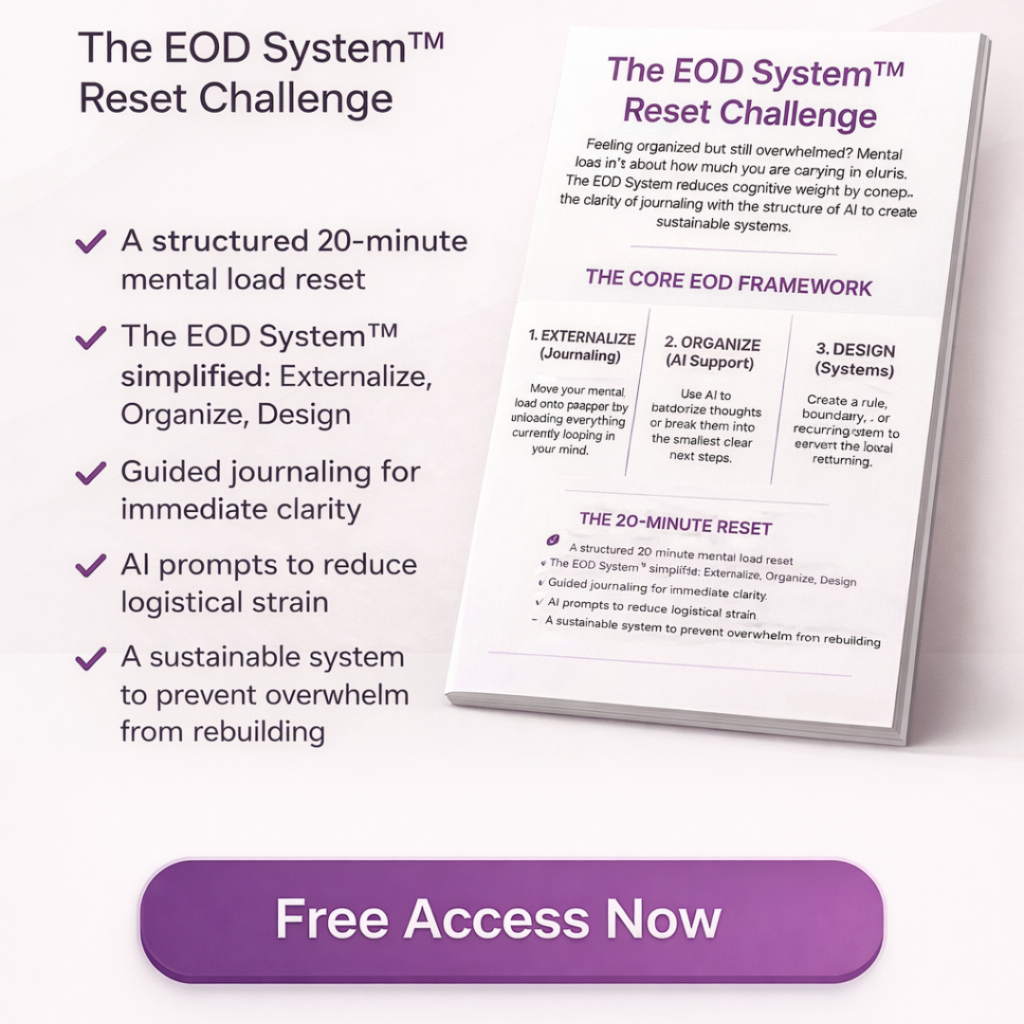
If you want more direct support, you can also book a Life Design Strategy Session or join the community space, The Prompted Life on Skool.
One question to sit with as you start: What’s one household task you’re tired of being the only one to remember? Name it clearly. That’s usually the first tab to close.
You don’t need to hold the whole house in your head
Household Mental Load isn’t just “a lot to do,” it’s the constant effort of tracking, remembering, and anticipating for everyone. Once you see the seven hidden tasks, the exhaustion makes more sense, and so does the solution. Use EOD to externalize what you’re carrying, organize it into something you can see, then design one system that stops the same stress from looping tomorrow. You deserve a home that runs on shared systems, not one person’s memory.



Share Your Thoughts