
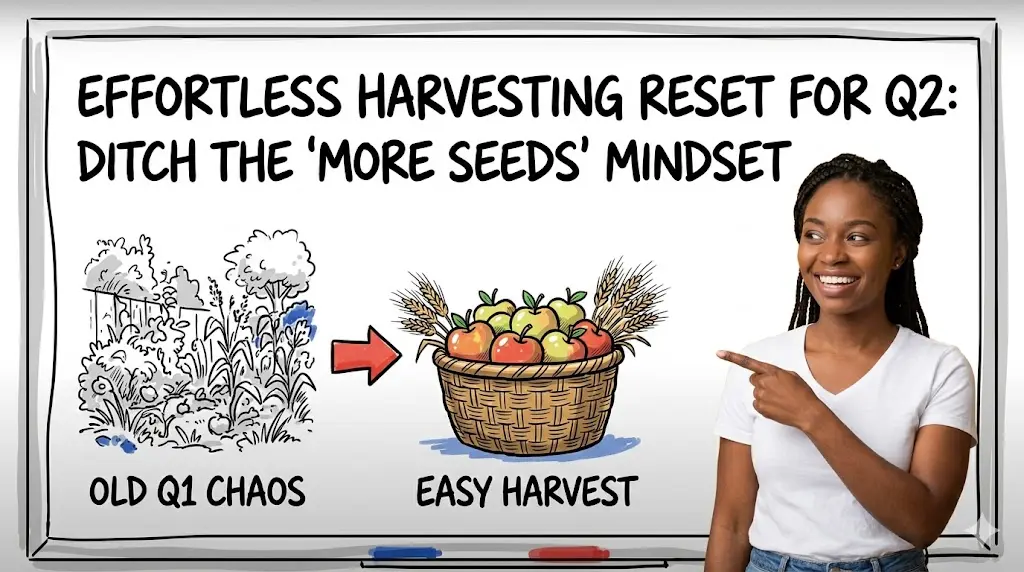
By April, a lot of smart, capable women stop feeling motivated and start feeling behind. The goals that looked exciting in January can turn into a quiet pile of guilt by spring.
That’s where a harvesting reset can help. Instead of adding more habits, more plans, and more pressure, this approach asks a better question: what is already growing, and what can you finally stop carrying?
Why April Makes Q1 Goals Feel So Heavy
April has a way of exposing the gap between what you planned and what your life could hold. The fresh-start energy of January fades. Then the untouched goals start staring back at you.
For many people, the problem isn’t discipline. It isn’t laziness either. The problem isn’t your willpower. The problem is the advice you’ve been given.
Most productivity advice tells you to respond to stress with more structure. If you feel behind, you’re told to tighten the system, buy a better tool, or start a new routine. That sounds helpful, but it often makes the pressure worse.
Common advice usually sounds like this:
- Buy a new planner
- Pick a new habit
- Set a new sprint
- Add another tracking system
- Start over on Monday
The issue is simple. When your mind is already full, adding more to manage doesn’t create relief. It creates noise.
That’s especially true for women carrying a heavy mental load at work and at home. Planning meals, tracking deadlines, remembering appointments, following up on messages, and trying to keep personal goals alive all pull from the same limited energy. This is why the idea of using AI to reduce mental load keeps gaining traction in conversations about work and life, including pieces like The high-achiever’s guide to ending digital mental load in 2026.
The better move in Q2 isn’t to force a bigger push. It’s to stop and look at what your first quarter was really telling you.
The Crowded Garden Problem Behind Half-Finished Goals
A helpful way to see Q1 is as a garden. Back in January, you planted a lot of seeds. Some of them came from excitement. Some came from pressure. Some came from the version of you that thought this would be the year you finally do everything.
Then the garden got crowded.
Your garden is overcrowded. Too many goals end up competing for the same sunlight, time, energy, and attention. When that happens, nothing gets enough care to grow well.
That crowded garden might include goals like these:
- Starting new habits
- Reading 50 books
- Going to the gym every day
- Building a new routine from scratch
- Keeping up with every personal and work priority at once

The usual response in April is to plant more. People buy new notebooks, make new schedules, and try to restart the year. But if the garden is already packed, adding more seeds won’t fix it. It only increases the strain.
You don’t need more seeds. You need to notice what’s already growing.
That shift matters because it changes the whole tone of Q2. Instead of asking, “What else should I be doing?” you start asking, “What already has momentum?” That question is calmer, clearer, and far more useful.
This is the core of the harvesting reset. You stop treating April like a second January. You stop trying to rescue every abandoned goal. Then you begin paying attention to the few things that took root.
Why the Harvesting Reset Works Better Than Spring Cleaning
A lot of April content pushes spring cleaning. On paper, that sounds fresh and productive. In real life, it can feel like one more project added to an already full plate.
The harvesting reset takes a different angle. Instead of sweeping away everything, you review the last 90 days and look for value. You stop focusing on what looks unfinished and start noticing what worked, even if it was small.
This quick comparison shows the shift:
| Spring cleaning mindset | Harvesting reset mindset |
|---|---|
| Clear everything out | Find what has value |
| Fix the mess | Notice the signal |
| Add effort to organize more | Reduce effort by focusing less |
| Start over | Continue what already has momentum |
| Judge what didn’t happen | Release what isn’t growing |
The takeaway is simple: harvesting reduces mental clutter because it rewards truth, not pressure.
This approach is practical because goals that aren’t growing still take up mental space. Even untouched goals can create stress. They sit in the background as reminders of what didn’t happen. That stress quietly drains energy.
The harvesting phase asks you to let that go. If a goal got mentioned over and over but never received action, it may not belong in your next quarter. Releasing it doesn’t mean you failed. It means you’re making room for something real.
That’s why this reset feels lighter than a clean-up spree. It is realism in action. You look at the last 90 days and ask what deserves care now.
The shift also moves you from pressure to enjoyment. Instead of forcing yourself toward the next thing, you get to notice what’s already working and build from there. That is often where momentum returns.
The Define, Design, Live Loop That Shapes Q2
The harvesting reset uses a simple three-part loop: define, design, and live. Each step lowers noise and helps you build Q2 around reality instead of guilt.
Define the few sprouts that truly took root
First, define what made real progress in Q1. This means looking for the few areas where you showed consistency, movement, or follow-through.
That sounds easy, but it often isn’t. Most people try to do this reflection in their heads. The problem is that your brain is a processor, not a storage unit. It’s not built to audit the last 90 days with clean objectivity.
When you rely on memory alone, you tend to focus on what feels loud. That usually means unchecked tasks, failed plans, and the “dead seeds” you still feel bad about. Our brains are bad auditors. They don’t naturally separate signal from guilt.
So the define step works best when you use outside support and raw data, not only memory.
Design a lean system for what’s already working
Next, design Q2 around the things that showed momentum. Not the things that sounded good. Not the goals that made sense on paper. Focus on the ones that lived in your real life.
This is where many people overcomplicate the reset. They want a full reinvention. What you need instead is a lighter system that waters the strong sprouts and leaves the rest alone.
That might mean keeping one habit instead of five. It could mean building your week around one repeatable win. It may also mean removing the goals that never moved past intention.
A lean system protects energy. It helps you stop scattering effort across too many priorities. That’s how progress becomes easier to keep.
Live with less noise and more permission
Finally, live the plan simply. This step is about permission.
Permission to stop watering goals that aren’t growing. Permission to stop carrying old plans as proof of effort. Permission to focus on what matters without apologizing for what got cut.
That matters because a simpler quarter often looks less exciting from the outside. Yet it usually feels better on the inside. You think more clearly. You finish more. You carry less.
This is also where the harvesting reset becomes more than a productivity method. It turns into a wellness choice. If a goal only creates stress, then letting it go may be the healthiest move you make all quarter.

Use AI as a Clarity Tool, Not a Task Generator
Most people use AI for addition. They ask it to create more tasks, draft more messages, or produce more ideas. That can be useful, but it can also pile more seeds into an already crowded garden.
At Digital Wellness Journal, the approach is different. AI is used for subtraction.
Instead of asking for more output, you give AI the messy record of your real life and ask it to find the patterns. That raw material can include journal entries, notes app thoughts, task lists, screenshots of messy calendars, half-formed reflections, complaints, or even prayers written during hard weeks.

AI helps because it doesn’t bring your emotional bias into the review. It doesn’t feel attached to the goals you thought you “should” have done. It looks for repeats, actions, themes, and signals. Then it points out where there was movement and where there was only intention.
That’s a different kind of support. It acts like an external auditor, not another source of pressure.
The goal isn’t to use AI to create a busier life. It’s to use AI to clear enough noise that you can see your life clearly.
This idea lines up with broader conversations about AI and the hidden work women carry, including Using AI to Manage Your Mental Load with Ajantha Suriyanarayanan. The strongest use case isn’t always speed. Sometimes it’s clarity.
When you use AI this way, it becomes a filter. It tells you where to focus. It highlights the few strong sprouts. Most importantly, it helps you stop watering the noise.
How to Run Your Q1 AI Analysis Prompt
Putting this into motion doesn’t need to be complicated. The process is simple, and the power comes from honesty.
Start by gathering the raw evidence of your first quarter. Don’t clean it up too much. Messy data is fine because the point is to review what really happened, not what you wish had happened.
Use this process:
- Gather your Q1 data, including journals, calendars, task lists, notes, screenshots, and reflections.
- Paste or upload that material into the AI platform you prefer.
- Ask AI to identify the three themes where progress is visible.
- Have it compare that progress against the goals you talked about but never acted on.
- Use the response to decide what belongs in Q2 and what needs to be released.
Here is the prompt shared with the video:
Act as an External Data Auditor with zero emotional bias. Your only job is to filter the ‘mess’ of my Q1 into a lean system for Q2.
ANALYZE THIS Q1 DATA: [Insert Journal, Tasks, Calendar data].
Separate the signal from the noise. Identify the 3 themes where progress is visible in the data. Compare this to the ‘Mental Clutter’ (stated goals with zero action). Provide a list of ‘Dead Seeds’ I need to remove from my garden so I can focus on what is actually working.
This prompt works because it asks for contrast. It doesn’t only ask, “What did I do?” It also asks, “What took up space without action?” That second part is where a lot of relief comes from.
If you want guided support for walking through this process in about 20 minutes, the EOD System™ Reset Challenge is one place to start. For more reflections on AI, journaling, and life design, the Digital Wellness Journal blog expands on these ideas.
Your Q2 Reset Checklist for Clearing the Clutter
Once your AI review is done, the next step is action. Not more action everywhere, but focused action in the right places.
Keep your Q2 reset simple:
- Audit your Q1 data without trying to defend it
- Run the AI analysis prompt
- Name the few seeds worth harvesting
- Remove goals that created guilt without movement
- Build your quarter around the patterns that already showed life

One part of this matters more than the rest: give yourself permission to clear the clutter. That is often the hardest step because unfinished goals can feel tied to identity. Still, if they aren’t growing, they don’t need daily attention.
This is the real reset. You stop treating yourself like a to-do generator. You start acting like a life designer.
A cleaner Q2 doesn’t mean a fuller calendar. It means a quarter where your energy has somewhere meaningful to go.
A Lighter Quarter Starts With Less
April doesn’t need to become a rescue mission for January. A better move is to look at what survived the first quarter and build from there.
The strongest idea in this reset is simple: stop watering dead seeds. When you let go of what never took root, you finally have space to enjoy what is working.
If you want more support with AI frameworks that protect your energy and reduce mental load, the Prompted Life Skool community is built for that next step. Happy harvesting.
Discover more from Digital Wellness Journal
Subscribe to get the latest posts sent to your email.


Share Your Thoughts