
You’re the one who remembers his mom’s birthday, the oil change, the friend who’s struggling, the overdue date night, and the weird vibe that started three days ago and still hasn’t been named. You can be sitting on the couch and still feel like you’re on shift, because your brain is quietly running the relationship behind the scenes.
That invisible work has a name: relationship mental load. Once you can name it, you can stop treating your exhaustion like a personal flaw and start treating it like a systems problem you can solve with your partner.
What relationship mental load looks like in real life

Relationship mental load is the invisible thinking that keeps your relationship and social life running. It’s planning, remembering, anticipating, coordinating, and doing emotional labor so things don’t fall apart. It’s not just what you do. It’s what you track.
If this feels familiar, it’s because it usually sounds like this:
- You remember the birthdays, gifts, and cards.
- You remember the car maintenance and appointments.
- You remember to check in on friends and family when life gets heavy.
- You remember to schedule date night because you can feel the distance creeping in.
- You remember the “little things” that keep the connection warm.
Here’s the part that messes with your head: none of that looks like work from the outside. It looks like you’re just being thoughtful. Meanwhile, your mind is holding a whole relationship operating system.
Date night is a clean example. It’s not only picking a restaurant. It’s noticing you haven’t had quality time in two weeks. It’s scanning both calendars. It’s searching places that fit the mood, budget, and timing. It’s making the reservation. It’s reminding your partner. It’s also managing the disappointment if they forgot what day it was.
The mental work of making it happen is what exhausts you.
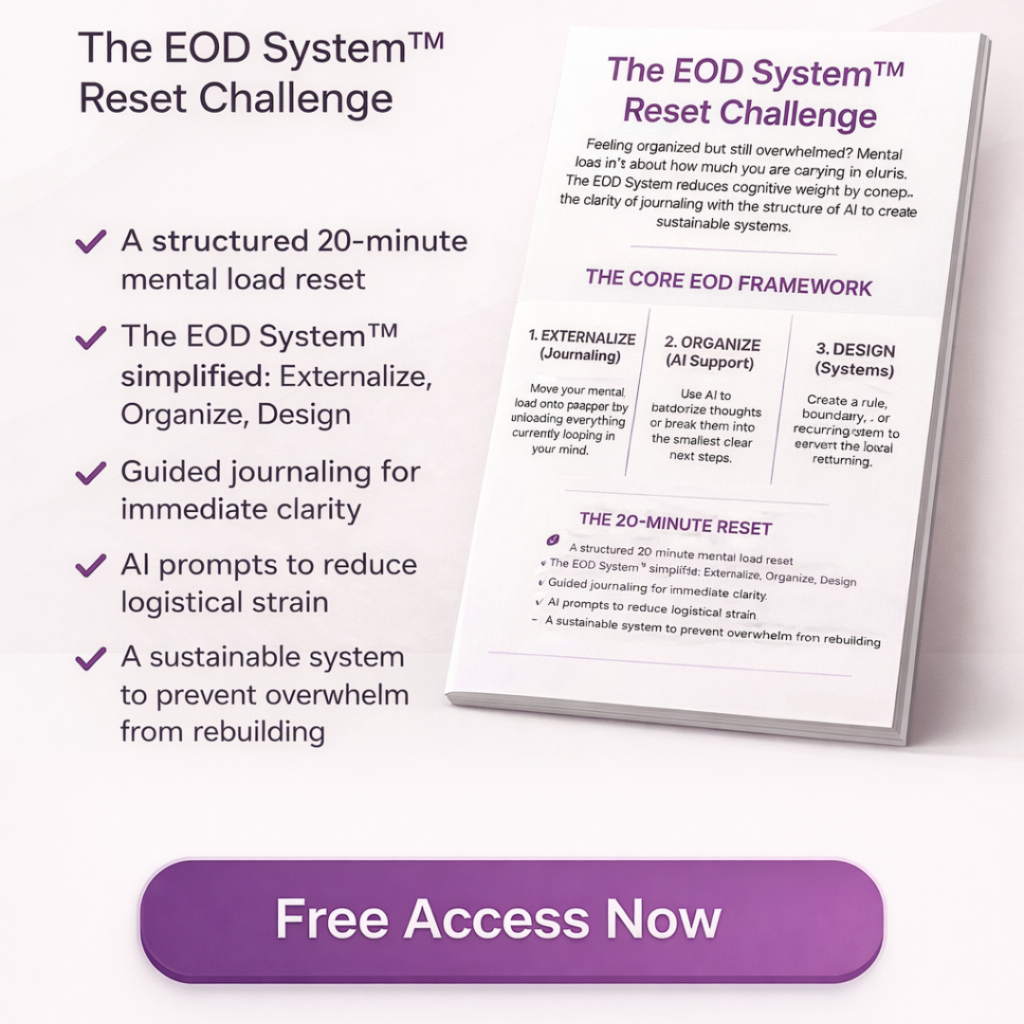
If you want a structured way to start offloading this tonight, you can use the free 20-minute EOD Reset Challenge. It’s built to help you get the weight out of your head and into a simple plan.
Why “just tell me what to do” makes you feel even more alone

When your partner says, “Just tell me what to do,” it can sound reasonable on the surface. The problem is what it quietly asks you to do next: become the manager.
Before you even answer, a whole extra job appears. You have to name the task, break it into steps, assign it, explain your preferences, remind them, follow up, and fix it if something goes sideways. So now you’re doing the relationship work and the management work.
That’s why it doesn’t feel like help. It feels like more work.
This pattern is common for three reasons.
First, a lot of women were trained early to be relationship managers. You were taught to remember dates, notice emotions, smooth tension, check on people, and keep the peace. Many boys weren’t taught that same “relational tracking” skill set. So as adults, you step into the role without even choosing it, and your partner may not realize what’s missing because they’ve never been expected to practice it.
Second, the work is invisible. Your partner doesn’t see you mentally tracking your mom’s birthday or noticing it’s been weeks since you laughed together. They see the end result: plans made, gift bought, reservation confirmed. Since they don’t see the thinking, they don’t value it the same way, and they don’t think to share it.
Third, you keep doing it because if you don’t, it often doesn’t happen.
If you want language for how common this is, resources like The Cadence Psychology can help you see the pattern outside of your relationship, which often reduces shame fast.
Use the EOD System to share the relationship mental load

The fix is not “try harder” or “communicate better” in the abstract. The fix is a structured shift that moves the load out of your head and into shared systems.
That’s what the EOD System is: Externalize, Organize, Design.
Externalize: get it out of your head (10 minutes)
Set a timer for 10 minutes and do a brain dump. Don’t organize. Don’t make it pretty. Just write down every relationship task you’re tracking, including social plans and emotional check-ins.
This is also a journaling moment, not just a list. Use one prompt to get honest without spiraling:
Journaling prompt: What am I quietly managing that nobody sees, and what does it cost me?
If you’ve been feeling overwhelmed in more than one area of life, it can help to name what kind of load you’re carrying (tracking, pending, and open loops). This post gives you language for that: system to manage mental load overwhelm.
Organize: let AI sort the pile
Once your brain dump exists, you can stop staring at it like a wall of noise. Paste it into an AI tool (like ChatGPT) and ask it to sort, prioritize, and point out what can be shared.
Use this prompt exactly, then paste your list where it says:
Role-based AI prompt (relationship load organizer):
I’m experiencing relationship mental load and need help organizing my tasks. Here’s my brain dump:
[Paste your list here]
Please help me:
- Categorize these tasks by area (social calendar, emotional labor, remembering tasks, parenting coordination, etc. )
- Identify which tasks are urgent vs. important
- Suggest which tasks could be shared with my partner, delegated, or automated
- Recommend one system I could create to reduce this mental load long-term
Format your response in a clear, actionable way.
This step matters because it helps you stop treating everything like it has the same weight. It also gives you cleaner language for what you’re asking your partner to share.
Design: build one system so it doesn’t boomerang back
Now pick one system to build this week. Not three. Not a full relationship overhaul. One small system that makes the load visible and shared.
Here are three options from the EOD approach:
Shared digital calendar. Put birthdays, anniversaries, appointments, and social events in one shared calendar. Add reminders for both of you. This is the simplest way to stop being the only “rememberer.”
Weekly relationship check-in. Schedule 15 minutes once a week (Sunday evening works for a lot of couples). You both share how you’re feeling and what you need. That way you’re not the only one monitoring the emotional temperature.
Rotating social planning. One month you plan social life, the next month your partner plans. Planning includes thinking it through and making it happen.
One small, visible action step (do this today): create a shared calendar event called “Weekly Check-In” and invite your partner right now. That single invite turns a hope into a structure.
If your mental load gets loud at night, pair this with a simple wind-down so your brain can stop scanning. This can help: nighttime wind down to offload mental load.
The conversation script that keeps your partner out of defense
You don’t need a speech. You need a clear, calm script that names the problem and points to a shared solution. Try this:
Hey, I want to talk to you about something that’s been weighing on me. I’ve been carrying a lot of mental load in our relationship, remembering birthdays, planning date nights, managing our social calendar, doing the emotional check-ins, and I’m exhausted.
I don’t think you realize how much I’m tracking in my head, so I made a list.
This is everything I’m managing, and I need your help. I don’t want to delegate tasks to you. I don’t want to be the project manager. I want us to share the mental load.
I’m proposing we create some systems together. Can we start with one? Let’s put all our important dates in a shared calendar so we both get reminders. That way, I’m not the only one who has to remember. What do you think?
The “what not to say” matters, because blame triggers shutdown. Skip lines like “You never help” or “You don’t care.” Even if those words feel true in the moment, they usually make your partner defend their character instead of changing behavior.
If you want a deeper read on how couples work on this, sharing the mental load in a relationship is a helpful outside perspective.
Try EOD tonight, then keep it going in a community
If you’ve been functioning while overloaded, you don’t need more pressure. You need a repeatable reset.
Start tonight with the free 20-minute EOD Reset Challenge. Do the brain dump, run the AI organize step, and pick one system to design. If it helps, bring your partner in with one simple line: “I want to show you what I’ve been carrying.”
When you’re ready for ongoing support, you can practice EOD weekly inside The Prompted Life community. It’s a place to keep building the kind of systems that protect your energy, without turning your life into another project.
If you’re noticing the load isn’t only in your relationship, a broader reset can help you choose what to fix first (instead of trying to fix everything). This guide can support that: personal life audit for relationship balance.
Key Takeaways
Relationship mental load doesn’t ease up because you finally “explain it better.” It eases up when you externalize what you’re carrying, organize it into something shareable, and design one system that keeps it from landing back on you. Start small, stay honest, and keep it concrete. You’re not asking for perfection, you’re asking for partnership.
Pin This for Later Inspiration
You deserve a life that feels like yours. Save these for days when you need to realign with your peace.



Share Your Thoughts