

Mental load exhaustion is why you can take the nap, cancel the plans, even get a “good enough” night of sleep, and still wake up feeling like your battery never charged. You’re functioning, you’re handling your responsibilities, you’re showing up, but it feels like you’re doing it on fumes.
That doesn’t mean you’re weak. It doesn’t mean you’re broken. It usually means you’re carrying unmanaged mental load paired with neglected physical maintenance, and it’s quietly draining you in ways you can’t always see.
If you’re the one everyone counts on, this hits different. You’re not falling apart, but you are tired of holding everything together in your head. This is the kind of exhaustion that doesn’t respond to “just rest,” because rest doesn’t close the open tabs running in the background.
Your mind isn’t failing, it’s overloaded with background processes
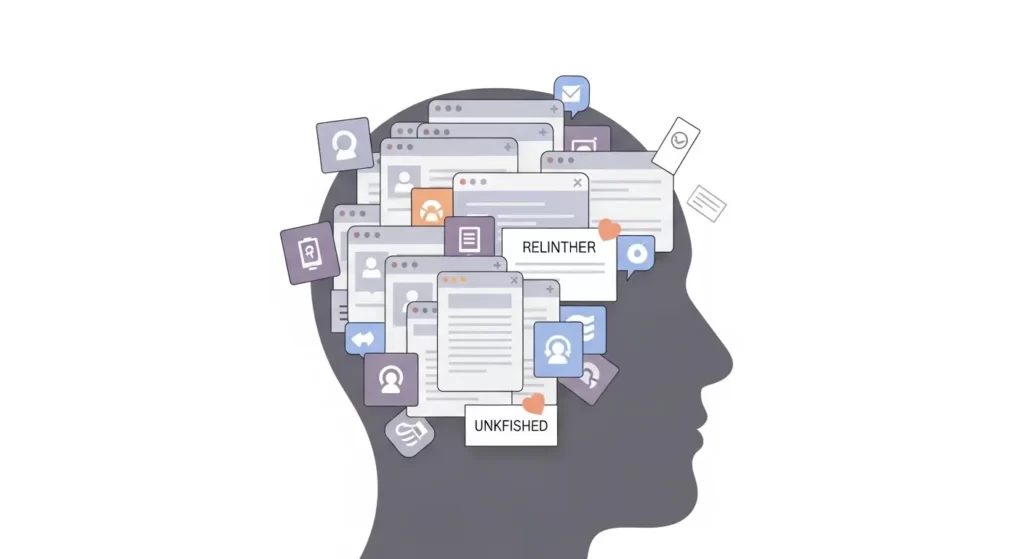
Picture your mind like a computer that has too many apps running at once. Nothing is fully crashing, but everything is slower, louder, and more fragile than it should be.
That’s what hidden mental load does.
Every unresolved task, every “I’ll deal with it later,” every small irritation you’ve learned to tolerate, it all sits in the background and pulls power. One thing by itself might feel minor. Together, they drain your core capacity.
Here are a few common “background processes” that steal energy without asking permission:
- An unresolved task you keep re-remembering (and re-stressing) all day
- Constant noise, notifications, or interruptions that keep your brain on alert
- A physical need you’re pushing past (thirst, hunger, tension, poor sleep)
The goal isn’t to push through harder. The goal is to restore your inner quiet, so your energy goes back to what actually matters. And the fastest way to do that is to stop treating this like a motivation problem.
Clarity reduces load immediately. When you can name what’s draining you, you can fix it with less emotion and more precision.
Classify your energy leaks into two categories (so you can fix them faster)
Most of what drains you fits into one of two buckets. When you sort the leak correctly, the solution gets simpler.
You’re not “lazy.” You’re not “undisciplined.” Your system is just out of balance.
System flaws: external friction you’ve normalized
System flaws are logistical and environmental issues that create unnecessary drag. They’re often small, which is why you learn to live with them. But your brain still pays for them every day.
These are the kinds of system flaws that quietly tax you:
- Cluttered spaces that create visual stress
- Constant noise (TV in the background, alerts, people talking around you)
- Unclear task boundaries (everything feels urgent, nothing feels finished)
- Friction you’ve accepted as “normal” (messy drop zones, missing supplies, no default routine)
- Too many visible decisions in your space (piles, sticky notes, half-finished projects)
The key is this: these are things you can remove or reduce mechanically. No mindset speech required.
This connects directly to your physical environment life area. Your space is either supporting your peace, or quietly picking at your nervous system all day.
Maintenance issues: biological debts your body is collecting
Maintenance issues are physical needs that haven’t been met, the basic inputs that keep your brain steady. When those inputs are off, your body acts like there’s an emergency, even if you’re pretending you’re fine.
Common maintenance issues include:
- Hydration that’s too low
- Low blood sugar (especially when you skip meals or live on caffeine)
- Poor sleep or short sleep
- Muscle tension you’re ignoring (jaw, shoulders, neck, hips)
- Cognitive fatigue from nonstop decision-making
Your brain treats unmet physical needs as emergencies, whether you acknowledge them or not. That low-grade alert can cut your usable focus dramatically, because part of you is always bracing.
This links to your health life area, and it also touches fun and recreation (because when you’re depleted, joy becomes one more thing you can’t access).
The Immediate Reset Protocol (15 minutes to stop the drain)

You don’t need a full life overhaul to feel better today. You need a short intervention that stops the biggest leak first.
This reset works because it handles the problem in the right order: body first, then environment, then mind. If you skip the body and try to “think your way out,” you’ll stay stuck.
Step 1: Physical stabilization (refuel before you think)
Start here, even if you don’t want to. Even if you feel annoyed that this is “so basic.” Basics are what keep you steady.
Do these in the next few minutes:
- Drink water. A real drink, not one sip.
- Eat something simple with protein or carbohydrates.
- Adjust your posture (uncurl your shoulders, relax your jaw, put both feet on the floor).
- If you didn’t sleep well, name it plainly: today’s capacity is capped.
This is calibration, not weakness. You don’t troubleshoot systems on a failing power supply, and you don’t fix mental overload with an underfed body.
If your exhaustion has been lingering, this step can also point to a longer-term support need. Sleep, food, movement, and hydration are not “extras.” They’re maintenance.
If bedtime is the hardest part for you, pair this reset with a nighttime wind-down routine to ease anxiety so your brain gets a clearer signal that the day is done.
Step 2: Environmental compression (remove friction, not “mess”)
Now you shrink the amount of input your brain has to manage. This is not a deep clean. This is not a weekend project. This is five minutes of strategic relief.
Try this:
- Clear only what you can see from where you’re sitting.
- Silence unnecessary noise (mute the TV, pause the podcast, turn off extra sound).
- Close unused tabs on your computer and on your phone.
- Reduce visible decisions (put away a stack, hide a pile, move one thing to a contained spot).
Your brain allocates energy to everything in view, whether you mean to engage it or not. When your space is loud, your mind stays loud.
This is the physical environment life area again. You’re not trying to create a perfect aesthetic. You’re trying to create relief.
Step 3: Cognitive offloading (get open loops out of your head)
If your mind is holding open loops, it won’t rest. It will keep tapping you on the shoulder like, “Don’t forget this, don’t forget that,” even when you’re trying to breathe.
So you write it down. All of it.
Not to solve it. Not to organize it beautifully. Just to relocate it.
The moment a task lives outside your head, it stops consuming active mental bandwidth. You’re not forgetting it, you’re storing it properly. Brains are not storage units.
Use this journaling prompt to start:
Journaling prompt: Where is my energy leaking right now?
If you want a structured place to keep those offloaded tasks (and turn them into simple repeatable systems), pull from the free so you’re not rebuilding the same solutions every week.

The DWJ SOP Vault
Stop trying to carry the mental load in your head. Access the Living Library of AI prompts designed to automate your overwhelm.
After the reset: protect your energy with delegation and batching
Once you’re stabilized, you can make smarter decisions. Not perfect decisions, just smarter ones.
This is where a lot of high-functioning women get stuck. You keep everything because you can do it. Because you’re capable. Because it’s easier than explaining. Because you don’t trust it’ll get done right.
And then you wonder why rest isn’t restoring you.
Ask one question for every open loop
Take what you wrote down and ask one question:
Does this require my attention right now?
If the answer is no, remove it from the present moment. That might mean you schedule it, park it on a list, or decide it’s not yours.
Even postponement counts as delegation when it’s intentional.
Choose a handling method that matches the task
You’re not doing “productivity.” You’re protecting your mind.
A few simple options:
- If it repeats, batch it (one time block, one mental setup).
- If it can be automated, assign it to a tool or reminder.
- If it doesn’t need your unique judgment, simplify it or release it.
This protects cognitive integrity, it’s not about productivity. High performers don’t have more energy, they have fewer leaks.
Use the 8 life areas to find the real source of the drain
Sometimes “I’m tired” is too vague to fix. A life area scan gives you a more useful target.
In the DWJ Life by Design approach, your life is held by eight areas: health, career and purpose, finances, relationships, personal growth, physical environment, spirituality and contributions, and fun and recreation.
When you’re exhausted, run a quick check:
- If your health is off (sleep, food, tension), you’ll feel fragile fast.
- If your career and purpose is demanding constant output, your brain never closes the workday.
- If your finances feel unstable, your nervous system stays on alert.
- If your relationships are draining, you spend energy managing emotion and expectations.
- If your personal growth is stalled, you can feel restless and stuck.
- If your physical environment is chaotic, you lose energy to friction.
- If your spirituality and contributions are empty, you lose joy, creativity, rest, and meaning.
- If your fun and recreation is missing, life starts to feel like one long obligation.
You’re not meant to fix all eight at once. You’re meant to notice what’s calling for care, then respond with one steady choice.
If you want a guided way to map what feels off and choose a starting point, use life balance mapping as a simple next step.
Start small today, stop the biggest leak first
You don’t need to fix everything today. You just need to stop the biggest leak.
Give yourself permission to be practical. Drink water. Eat something. Clear the surface in front of you. Write the open loops down. Choose one thing to delay or delegate on purpose.
Try this five-minute reflection from the video:
What is one unresolved thing living in your head that you can safely move out of it today?
If you want to do this kind of work with more support, you can join the systems-based work inside DWJ Life by Design or connect with other women doing the same in the DWJ community group.
The Takeaway
Rest starts working again when you stop asking it to do the job of clarity, maintenance, and boundaries. Your core takeaway: you’re not tired because you’re doing too much, you’re tired because too much is running in the background.
One more journaling prompt: What’s the biggest leak you’re willing to close this week, and what would “good enough” look like?
Keep it simple, keep it honest, keep it doable. If you want more support building real-life systems (not pep talks), spend time in the AI tools for everyday women section and choose one small tool that meets you where you are.
Pin This for Later Inspiration
You deserve a life that feels like yours. Save these for days when you need to realign with your peace.
Discover more from Digital Wellness Journal
Subscribe to get the latest posts sent to your email.


Share Your Thoughts