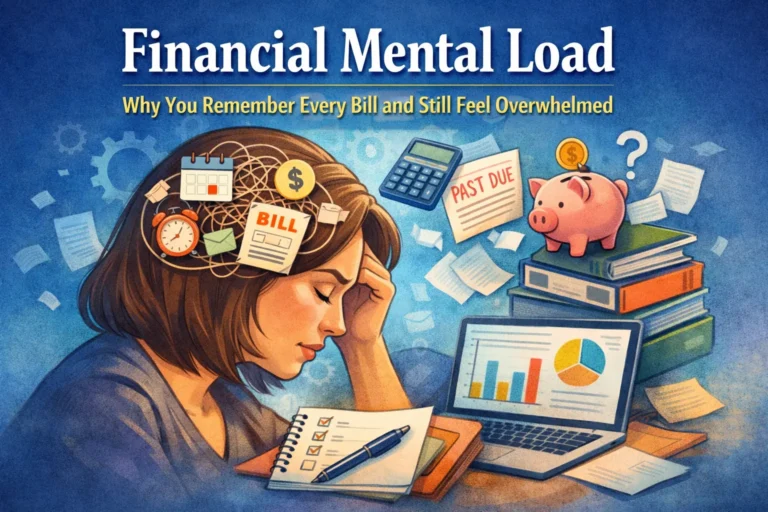
You finished the workday, but your brain didn’t get the memo. You replay the meeting that went sideways, draft tomorrow’s email in your head, and brace for the hard conversation you keep avoiding. You’re home, yet you’re still “on.”
That after-hours spiral has a name: career mental load. It’s the invisible thinking and emotional work wrapped around your job, and it quietly steals your rest.
This is designing a life less loaded, and it starts with noticing what’s actually happening.
Table of Contents
What career mental load really is (it’s not just stress)

Career mental load is the invisible work of managing your professional life. It’s not the task you did, it’s everything your mind keeps running around the task. You track, anticipate, manage relationships, monitor how you’re perceived, and carry emotional weight that never makes it onto your calendar.
Here’s what that invisible load can include:Alright give me the meta description.
You finish your work day but your brain didn’t go get the memo. You reply, you play them in meaning and I got them; that’s our man so my people say the raptor arrived in good condition. You boys didn’t cut this up; I’ll be amazed.
I do have another job for you. Sure, hot money’s double. What’s the cargo? I draw surrounding trained to kill, whoever they’re told. Laser marks the target; they attach to the scent. Don’t stop; it’s dead, inescapable. Those idiots making hybrids have it all wrong. We can’t engineer loyalty and to nurture it so this makes me upset.
What are they doing here? I don’t know. I’m not going to do that. I’m going to do that.
- Tracking what’s due, who needs what, and what might fall through the cracks
- Anticipating problems before they happen (and trying to prevent them)
- Managing relationships and workplace dynamics
- Monitoring reputation (how you came across, what they meant, what they noticed)
- Emotional labor before, during, and after work hours
A meeting is a perfect example. The meeting itself might be one hour. The mental work around it can run all day:
- You prepare what you’ll say and how you’ll say it.
- You read the room in real time.
- You manage tension between people who don’t get along.
- You notice who stayed quiet, then you wonder why.
- You track action items and who might not follow through.
- You replay your tone, your face, and your words on the drive home.
The mental work around it runs all day, even when the calendar block ends.
Why career mental load hits professional women harder
This load tends to land heavier on professional women, partly because you’re often expected to do extra “people glue” work without it being named as work. Then it becomes normal. Then it becomes yours.
The emotional labor tax at work
Many workplaces still reward women for being warm, supportive, and tuned in, even when nobody calls it a requirement. So you become the person who notices.
You catch that a colleague is struggling. You smooth over conflict before it escalates. You make sure people feel included. You remember birthdays. You organize the team thing. You protect the vibe.
That is emotional labor, and it’s cognitively demanding. It also tends to be undervalued. It rarely shows up in a performance review, and it doesn’t come with a raise.
If you want language for this pattern, this piece on invisible emotional labour and women’s mental health costs puts words to what you’ve likely been doing on autopilot.
The “office mom” default
In a lot of workplaces, women get assigned a role that looks helpful, but acts like a trap: the office mom.
People come to you for problems. You know where things are. You remember what everyone is working on. You pick up slack when someone drops the ball.
Nobody formally asked you to do it. It just happened because you were good at it. Because you were reliable. Because you said yes once, and now it’s an expectation.
Only one of those things is actually your job description.
The visibility trap that keeps you “on” at 10:00 p.m.
The work that exhausts you most is often the least visible. Your deliverables get noticed. Your presentations get noticed.
Meanwhile, the hours you spend managing up, managing sideways, smoothing conflict, and keeping everyone aligned can disappear into thin air. So you try harder to be seen. You take on more. You stay later. You answer the email at 10:00 p.m. because you’re afraid that if you stop, you’ll fall behind.
That’s the visibility trap, and it keeps career mental load running 24/7.
The work that exhausts you most is often the work that was never yours to carry.
A simple structured shift: use the EOD System to clear the noise
You don’t need a whole new personality to fix this. You need a repeatable way to take what’s in your head and put it somewhere safer.
Tamberly, creator of Digital Wellness Journal, teaches the EOD System, which stands for Externalize, Organize, Design. The goal is simple: you stop storing your career inside your body.
If you want a deeper foundation for why “open loops” drain you, this guide on managing mental load overwhelm breaks down the invisible inventory your mind keeps tracking.
Externalize: get work out of your head
Tonight, set a timer for 10 minutes. Do a brain dump. No filtering. No organizing. Just get it out.
Write down every work-related thing you’re carrying, including:
- Tasks you’re tracking
- Worries you keep circling back to
- Relationship dynamics you’re monitoring
- Conversations you’re dreading
- Emails you’re composing in your head
As long as it’s in your head, it runs in the background, even when you’re trying to rest.
Organize: use AI as a thinking partner (not a boss)
After you brain dump, paste it into an AI tool (like ChatGPT) and ask it to sort the mess into something you can see clearly.
Here’s a role-based prompt you can use as a professional woman managing a full plate:
I’m experiencing career mental load and need help organizing my work-related tasks and stressors. Here’s my brain dump:
[Paste your list here]
Please help me:
- Categorize these by area (deliverables, relationship management, emotional labor, communication, career development, etc.)
- Identify which tasks are urgent vs. important
- Flag anything that may not actually be my responsibility
- Recommend one boundary I could set to reduce this mental load long-term
Format your response in a clear, actionable way.
That third request matters. A lot of what drains you isn’t actually your job. Seeing that on paper can be the moment your shoulders drop.
Design: choose one boundary that stops the repeat cycle
Design is where you make the load smaller tomorrow than it was today. You don’t do it with willpower. You do it with a boundary you can repeat.
Pick one script below and test it for a week.
Three boundary scripts you can use this week (word-for-word)

Boundary 1: the work-hours boundary
Pick a cutoff time (6:00 p.m., 7:00 p.m., whatever fits your life). After that time, work is done.
Use this script:
“I’m fully present during work hours and typically respond to messages by 6:00 p.m./7:00 p.m. For anything urgent [alternate contact/email].”
Make it visible so you don’t have to keep explaining yourself. Set it as an after-hours auto-reply. Put it in your email signature. Say it out loud to your team. Then stick to it.
Small visible action step: set the auto-reply tonight. That one move reduces decision fatigue immediately because you’re not renegotiating your boundary every time you see a notification.
Boundary 2: the not-my-job boundary
When someone hands you a problem that belongs to them, resist the reflex to solve it.
Use this script:
“That sounds important. What do you think is the best next step?”
It’s collaborative, not cold. It also redirects ownership back to the person who actually has it, which keeps you from becoming the default fix-it person.
Boundary 3: the emotional-labor boundary
You can care without carrying. When someone vents or brings drama to you, you’re allowed to be supportive and still protect your energy.
Use this script:
“I hear you. That sounds really frustrating. I have [X] on my plate right now, but I hope it gets better.”
You acknowledge them. You show warmth. You also don’t take their stress home with you.
One journaling prompt that helps you stop storing work in your body
Before bed, write for three minutes:
What part of work am I still holding, even though the workday is over?
Then add one more line:
What’s the smallest “close the loop” step I can take tomorrow?
If sleep is where career mental load hits you hardest, pair this with a calming routine. This guide to a nighttime wind down for anxiety fits especially well when your mind won’t stop drafting emails in the dark.
Try the 20-minute reset, then bring your energy back to you

If you want a guided version of this, use the free 20-minute EOD Reset Challenge. It walks you through Externalize, Organize, Design so you can clear career mental load before bed and actually rest.
If you’re ready to practice this weekly with support, step into The Prompted Life community. That space is built for multi-role women who are tired of holding everything internally, but still want a calm, workable system.
You can also talk it through in a focused way by booking a conversation through Let’s Talk Load.
Career mental load doesn’t mean you’re weak, it means you’ve been carrying invisible work without a container. Externalize what’s looping, organize it so you can see what’s yours, then design one boundary that makes tomorrow lighter. Start small, because one boundary repeated beats a perfect plan you never use. Your clear takeaway: if work keeps following you home, give it a place to land, and give yourself permission to stop carrying it.
Discover more from Digital Wellness Journal
Subscribe to get the latest posts sent to your email.