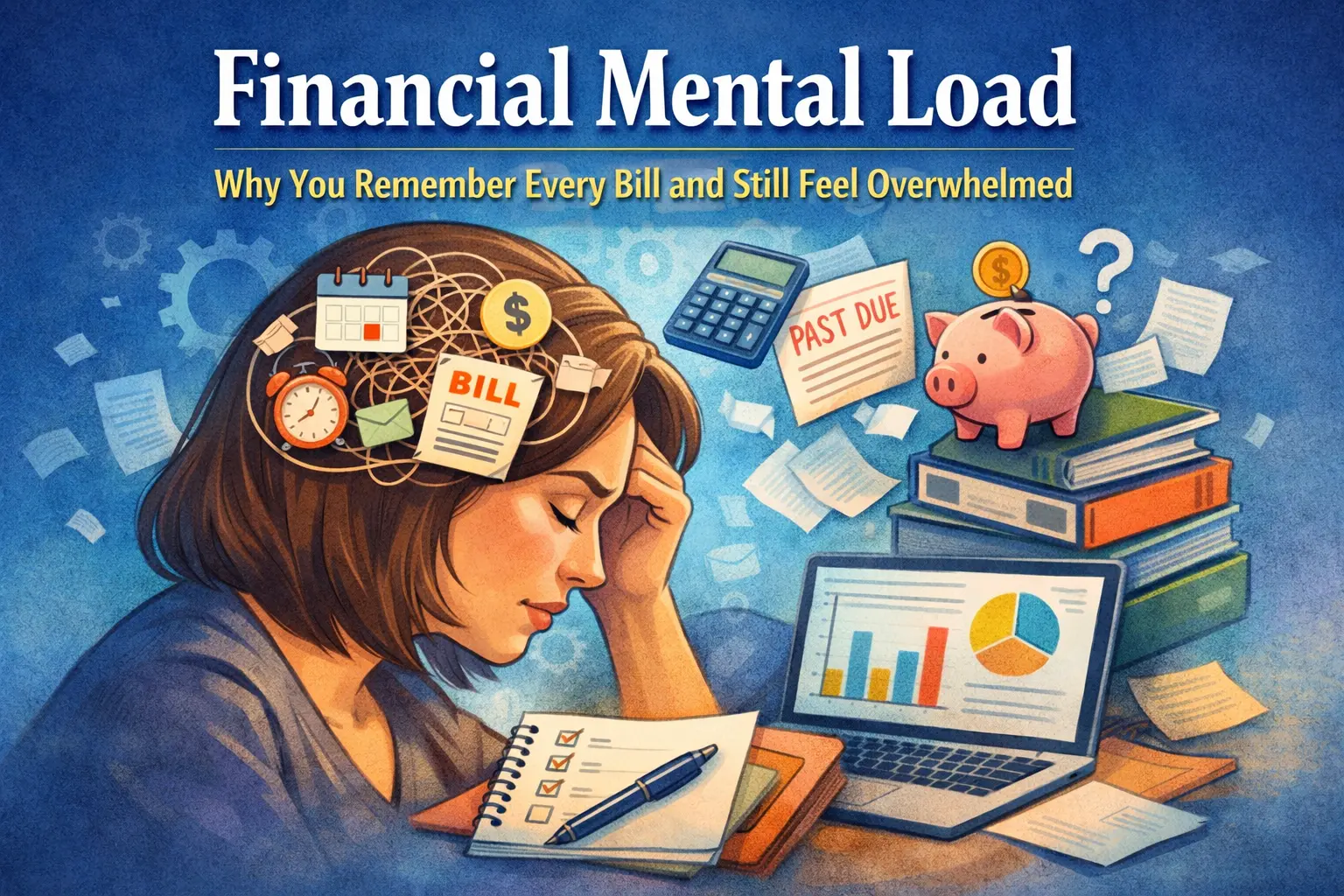
You can probably tell someone exactly how much is in your checking account right now. You know when your mortgage is due, when your electric bill spiked, and when your insurance renews.
Most of that isn’t written down. It lives in your head.
That’s financial mental load.
It’s not just money stress. It’s the constant background work of remembering, tracking, checking, and adjusting, even when you’re supposed to be resting.
Table of Contents
What financial mental load really is
Financial mental load is the invisible thinking work behind managing money.
Paying a bill takes two minutes.
Thinking about that bill can take days.
You notice a charge is higher.
You start recalculating your budget in your head.
You adjust before you even open your banking app.
It often looks like:
- Noticing a bill is higher than expected
- Mentally adjusting your budget throughout the day
- Remembering which account pays what
- Deciding whether to move money
- Carrying low-level financial worry in the background
The task is small.
The mental load is constant.
Money feels heavier because it touches everything. Home, food, health, kids, work, and future plans all run through it.
So your brain stays on alert.
If this sounds familiar, you’re not failing. You’re carrying an invisible inventory, the same kind of pattern behind managing mental load overwhelm.

The 7 money tasks quietly draining your energy
Financial exhaustion is rarely about income alone.
It comes from the open loops your brain never gets to close.
Here’s what you’re likely carrying:
| Money task | What you’re holding in your head | Why it drains you |
|---|---|---|
| Tracking every bill | Due dates, autopay status, which account pays what, fixed versus changing bills | Missing one has real consequences, so your brain stays vigilant |
| Running a live budget | Grocery math, how much is left before payday, whether a purchase can wait | You’re budgeting in real time, all day |
| Managing subscriptions | Streaming services, apps, renewals, memberships you meant to cancel | Small charges keep pulling while the decision stays unfinished |
| Worrying about long-term goals | Retirement, debt payoff, emergency savings, larger plans | The gap between what you want and what’s happening keeps looping |
| Overseeing insurance | Deductibles, in-network care, car insurance rates, open enrollment | You’re tracking a full set of products and choices |
| Carrying taxes year-round | Receipts, deductions, withholding changes, documents, filing choices | Tax stress isn’t seasonal when your mind is tracking it all year |
| Making constant financial decisions | Card or cash, save or spend, pay extra debt or build savings | Repeated choices wear down your judgment and energy |
When all of this stacks, you’re not just managing money.
You’re acting as the system.
The EOD system for financial mental load (Externalize, Organize, Design)
The goal is simple.
Stop storing your financial life in your head.
Step 1: Externalize (Brain Dump)
Take 10 minutes and write down:
- Every bill
- Every due date
- Every money worry
- Every decision you’ve been delaying
Prompt:
What money task is taking up more space in my mind than it should?

Step 2: Organize (Use AI as a Thinking Partner)
Use this prompt:
Act as my financial thinking partner. I’m experiencing financial mental load and need help organizing my money tasks. Here’s my brain dump: [paste your list here]
Please help me:
- Categorize these tasks by area, such as bills, subscriptions, savings goals, insurance, and taxes
- Identify which tasks are urgent versus important
- Suggest which tasks could be automated, simplified, or eliminated
- Recommend one system I could create to reduce this financial mental load long-term
Format your response in a clear, actionable way.
Step 3: Design (Create One System)
Start with one:
- A simple financial dashboard (Google Sheet or app)
- Autopay for fixed bills
- A weekly 10-minute money check-in
You don’t need more effort.
You need a place for this to live.Thank you for watching. All right. Okay.
If money stress is tied to a wider season of overload, a personal life audit for balance can help you see what else is competing for your energy.

Why Systems Reduce Financial Stress (Not Discipline)
This is where most people get it wrong.
You don’t need to try harder.
You need to stop holding everything mentally.
When your finances live in a system:
- bills don’t get missed
- decisions don’t pile up
- your brain doesn’t stay “on” all the time
It doesn’t fix your finances overnight.
It removes the weight of managing them alone.
If you want ongoing support using journaling and AI to reduce overwhelm in real life, you can explore The Prompted Life community.
Clear your financial mental load tonight
Set a 10-minute timer before bed and write down every money task your brain is still holding. Then choose one small system, a dashboard, autopay, or a weekly check-in, and put it in place this week.
You do not need to fix your whole financial life tonight. You just need to stop asking your mind to be the storage unit for all of it. That’s the takeaway: relief starts when what you’re carrying gets a place to land. Keep going, one small system at a time.
Discover more from Digital Wellness Journal
Subscribe to get the latest posts sent to your email.