
Mental load overwhelm can show up even when you’re finally sitting down to rest. You can be physically still and still feel like your brain is running laps. You forget what you came into the room for, feel irritated for no clear reason, and cannot shake the sense that something is always waiting on you.
That isn’t laziness. It isn’t a character flaw. It’s mental load, and it adds up fast when you’re the one who remembers, tracks, anticipates, and holds it all together.
You’re not failing, you’re carrying an invisible load
When you feel overwhelmed, it’s easy to assume you’re “behind.” Behind on routines, behind on discipline, behind on organization. But most of the time, the real issue is simpler and heavier at the same time.
You’re carrying an invisible inventory.
It’s the constant background thinking that never makes it onto your calendar. The quiet remembering. The scanning. The anticipating. The emotional tracking of everyone around you. You might be functioning, even thriving in certain areas, but inside you’re managing a thousand tiny mental tabs.
This is why you can be “off” even on a calm day. Nothing is on fire, but nothing in you is fully at rest.
Here’s the shift that matters. This is not about fixing yourself. It’s about understanding what you’re holding so you can decide what actually deserves your energy.
So as you read, keep one posture. Stay curious, not critical.
Curious sounds like: “Oh, that’s what’s been taking up space.” Critical sounds like: “Why can’t I just handle this?”
You don’t need more shame. You need a clearer map.
And if you want a gentle way to zoom out beyond the day-to-day, it helps to look at your life in sections, not as one big mess. The life balance mapping process is built for that, it helps you see which areas are asking for support (without turning it into another project).
Mental Load Overwhelm: What It Really Is and Why It Drains You
Mental load is not just “a lot to do.” It’s unfinished thinking. It’s the open loops your brain keeps replaying because it doesn’t trust they’re safe anywhere else.
Think of your mind like a computer.
- A processor is meant to run tasks.
- Storage is meant to hold files.
Your brain is great at processing. It notices patterns, makes meaning, picks up cues, and keeps you aware. But when you try to use your brain as long-term storage, it starts to run hot. You get foggy. You get scattered. You get snappy. You feel tired even when you sleep.
That constant scanning is your mind trying to protect you from dropping the ball. It keeps whispering, “Don’t forget. Don’t miss it. Don’t mess up.” The intention is safety. The cost is fatigue.
This is also why telling yourself to “focus” doesn’t always work. Focus is hard when your brain is juggling background tasks you never agreed to carry.
If you want language for what’s happening in your body, stress research backs this up. When you stay in a prolonged state of pressure, your nervous system can stay activated even when you stop moving. The American Psychological Association’s overview of how stress affects the mind and body is a solid reference if you want the science behind that wired, worn-out feeling.
The point is not to diagnose yourself. The point is to stop blaming yourself.
Once you name mental load for what it is, you can stop treating your exhaustion like a personal failure, and start treating it like a systems problem.
The 3 categories of mental load (spot your invisible inventory)
Most mental load tends to live in three quiet categories. When you can sort what’s in your head, your overwhelm gets less mysterious. You start to see why your mind feels crowded even on “easy” days.
1) Tracking: the mental tabs you keep open
Tracking is all the ongoing monitoring you do without even calling it work.
You’re mentally keeping tabs on appointments, deadlines, school stuff, household needs, bills, birthdays, and who needs what emotionally. You remember to reorder the thing before it runs out. You notice the mood shift in the room. You keep the thread of the week in your head so everything doesn’t fall apart.
Nothing is necessarily wrong, but nothing is fully off.
Tracking can look like replaying your schedule while you’re brushing your teeth, or reviewing tomorrow’s logistics while you’re trying to watch a show. Your body is sitting down, but your brain is still on duty.
2) Pending: the unresolved decisions that follow you around
Pending load is what you haven’t decided, finished, or closed.
It includes conversations you still need to have, tasks you keep postponing, emails you haven’t answered, choices you do not have the energy to make, and situations that feel emotionally unfinished.
Pending load is heavy because it has edges. It pokes at you.
Even if you don’t touch the task, it touches you. It shows up when you’re driving. It shows up when you’re trying to fall asleep. It shows up in that low-grade dread you cannot quite explain.
3) Homeless ideas: thoughts that matter but don’t have a place
These are the important thoughts that float.
Creative ideas, worries, reminders, reflections, “I should remember to…,” “Don’t forget to…,” “I need to think about….” They don’t have a home, so they keep resurfacing at random times.
Homeless ideas are sneaky because they feel like insight, but they function like clutter. They take up space, then disappear, then come back louder because your mind is trying not to lose them.
Once you can say, “Oh, this is tracking,” or “This is pending,” or “That’s a homeless idea,” you stop treating your overwhelm like a personality trait. You start treating it like inventory.
The big reframe: your mind is for awareness, not storage
Hold this as a principle: your mind is excellent at awareness, pattern recognition, and meaning-making. It is not designed to hold everything indefinitely.
When you use your brain as a storage unit, you overload the system. That overload is what often shows up as mental fog, irritability, and that scattered feeling that makes you question yourself.
External support is not weakness. It’s a design choice.
Writing things down, naming them, giving them somewhere to rest, that’s how you give your mind permission to stop scanning.
This is where clarity starts, not by doing more, but by carrying less internally.
And if you need proof that this is not “just you,” cognitive research has long recognized that working memory is limited. You can only hold and manipulate so much information at once before performance drops and stress rises. If you want a deeper explainer, the SimplyPsychology overview of working memory and its limits puts language to what your body already knows.
So no, you do not need a better brain. You need a safer place to put what your brain is holding.
Externalize your mental load (so your nervous system can exhale)

Once you decide to externalize, the goal is not productivity. The goal is relief.
When something is captured outside your head, your nervous system does not have to keep tapping you on the shoulder to remember it exists. That is why journaling and brain dumps can feel calming. You are not fixing your life, you are giving your mind a break.
Start simple. Choose one “sanctuary” for your thoughts, and keep it consistent for a week.
- Pick one landing spot: a notebook, a notes app, or a single document you can always find.
- Empty your head for 3 to 5 minutes, without organizing.
- Label what you wrote as Tracking, Pending, or Homeless Ideas.
- Choose one tiny next step for one Pending item, then stop.
That’s it. You’re not trying to complete your list. You’re trying to stop carrying it in your body.
If you want a ready-made structure for this, use the Brain-Off Reset Guide as your container. The value is not the tool itself, it’s the permission it gives your mind to stand down.
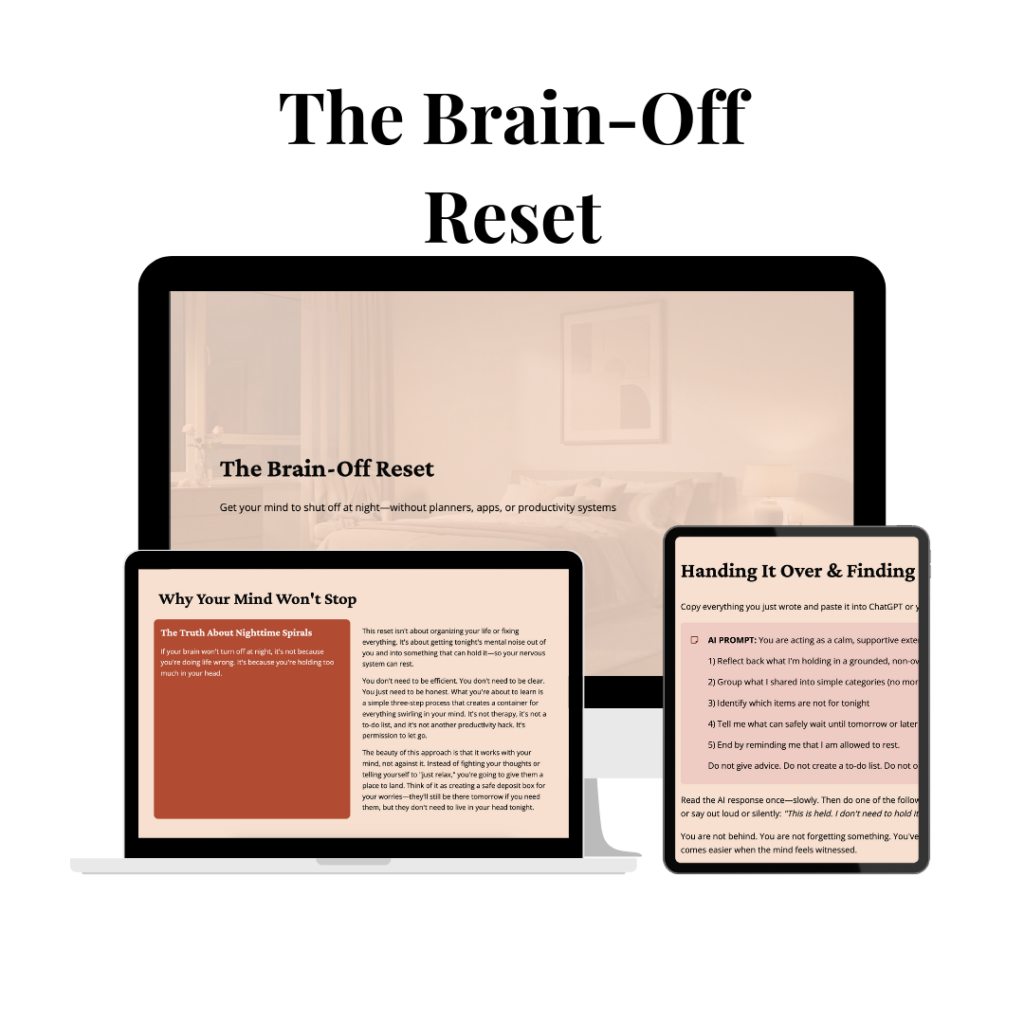
- Quiet your racing thoughts — learn a simple nightly reset ritual that calms mental overactivity and helps your mind release the day.
- End decision fatigue — step away from planners, screens, and productivity guilt with an easy 5-minute guided reflection.
- Restore deep rest — reconnect your body and brain so you can fall asleep faster, wake up lighter, and start the next day centered.
And if your overload gets loud at night, you don’t need a perfect bedtime routine. You need closure. A brain dump to reduce mental load can help your mind stop reviewing the day when your body is begging for sleep.
Your gentle starting question (this is where your design begins)
Now pause. Not to solve. Not to optimize. Just to notice.
What is one thing your mind is most tired of holding right now?
Write it down as one sentence. No explanation required.
If you want a simple way to go one layer deeper, use a short reflection cycle:
- What am I aware of right now?
- What emotion is attached to it?
- What do I need that I’m not naming?
- What is one small action that would create relief?
You can also anchor this to your bigger life picture. When one area of life is quietly out of balance, mental load often spikes without warning. If you want gentle support stepping back and seeing what’s asking for attention, the Life Balance Mapping resources offer a simple way to reflect without turning it into another heavy project.

Come back to the point: you’re allowed to carry less
Your core takeaway is this: overwhelm is often a storage problem, not a motivation problem.
You don’t have to solve everything today. You just have to stop storing everything in your head.
Journaling prompt: What is one thing your mind is most tired of holding right now, and where can you put it so you’re not carrying it alone?
Be gentle with yourself as you practice this. Your brain has been trying to protect you, it just needs support.
If you want more grounded systems for clarity and balance, you can explore the Digital Wellness Journal resources and keep building your life one small design choice at a time.
Pin This for Later Inspiration
You deserve a life that feels like yours. Save these for days when you need to realign with your peace.
Discover more from Digital Wellness Journal
Subscribe to get the latest posts sent to your email.