
If you’ve ever tried 90-day planning with AI or even thought about it, you know the hardest part isn’t the data. It’s the moment after the audit when you’re staring at your scores, wondering, “Okay… now what?”
That was me. I had hard data on how my life actually felt across eight areas, and it showed some real leaks in my world, especially around money and joy. Helpful, yes. But it did not tell me where to go next or what a better season could actually look like in detail.
Data tells you where you are, but it doesn’t tell you where to go.
This is where the design part comes in. In this post, I am walking you through how I used my Design Your Next 90 Days workbook, plus a custom AI bot I built, called Picture Perfect Life by Design, to turn my messy reality into a clear 90-day vision.
No vision board glue sticks needed. No staring at a blank page waiting for “inspiration.”
At a Glance: What This Process Does
This process helps you move from knowing something is off to clearly seeing what alignment looks like over the next 90 days. It starts with a life audit to ground you in reality, uses an analog workbook to clarify how you want your life to feel, and then layers in AI to refine and organize your vision into a clear Life by Design snapshot. The result is focus without pressure, direction without overwhelm, and a practical bridge between where you are now and where you want to be.
Here is the full walkthrough in video form if you prefer to watch first:
Table of Contents
How 90 Day Planning With AI Changed the Way I Design My Life
Why Knowing Your Scores Is Not Enough
In a previous session, I used my Personal Life Evaluation Assessment and scored myself across eight life areas. From the description context, my numbers told a very honest story:
- Finances were around 2.3
- Joy or fun was around 2.5
Both of those fell into the “this is not working” zone.
If you want to see that first step in action, you can watch The Life Audit or take the same assessment yourself using the free life assessment.
That audit step is what I call the Discover Where You Are phase in the Design Your Next 90 Days process. It is important. It grounds you. It keeps you from setting random Pinterest goals that do not match your real life.
But then a big question shows up:
“Okay, I know I am at a 2.3 in finances and a 2.5 in joy. Where do I actually want to go?”
Numbers alone will not answer that. You need a picture. A feeling. A direction.
Research on intentional living shows that clarity comes not just from awareness, but from consciously choosing how you want to live and designing your days around those values, not just reacting to circumstances.
That is where the next phase begins.
Step 1: Build Your Analog 90-Day Vision in the Workbook
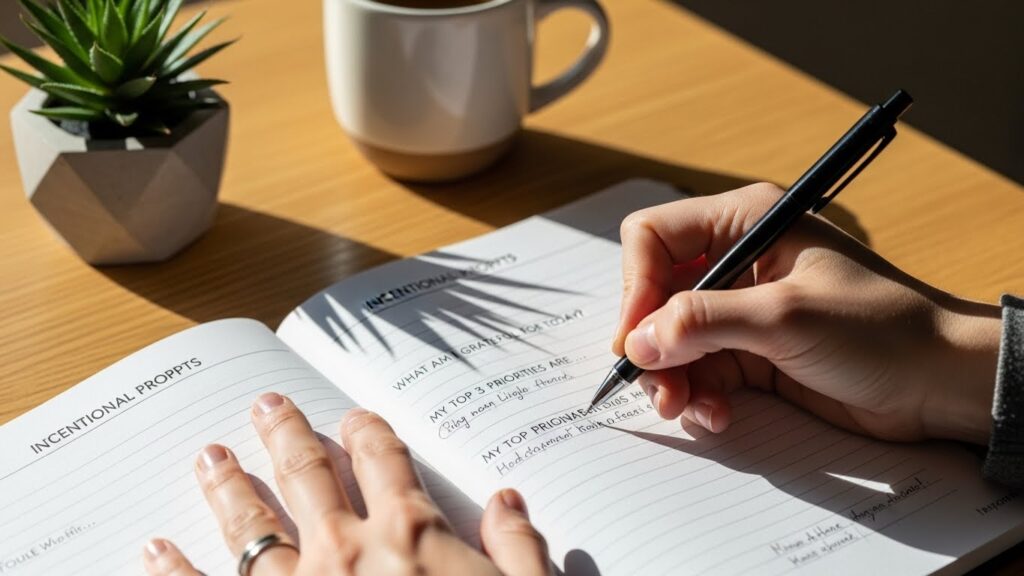
Before I touched any tech or AI, I started old-school: with my interactive Design Your Next 90 Days workbook. This is the analog vision step. It is simple on purpose, so your brain does not freeze.
The workbook walks you from data to desire, from scores to story, and from “I do not know” to “Here is what I want this next season to feel like.”
You can grab your own copy of the workbook through Design Your Next 90 Days if you want to follow along with your life as you read.
The Key Prompt: What Does Alignment Feel Like?
The workbook gives a powerful starting question:
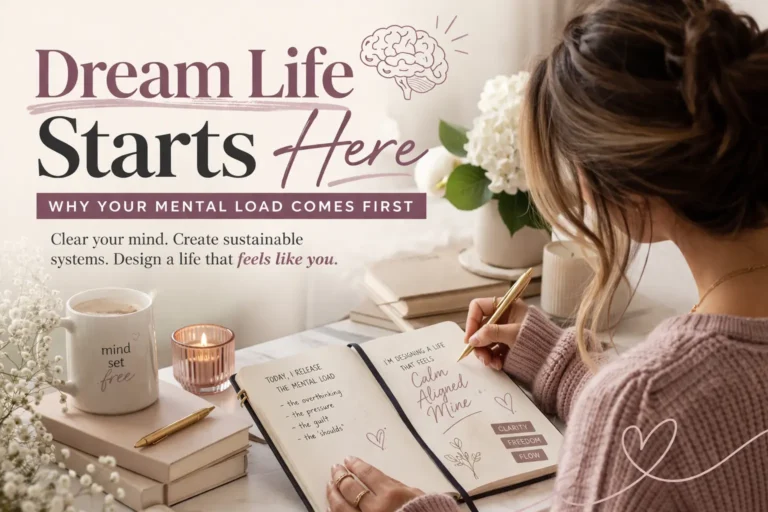
“If my next 90 days felt aligned, what would that look and feel like?”
Not perfect. Not aesthetic. Aligned.
When I answered that for myself, what came out was:
- Stability
- Ease
- Intention
I wrote that my next 90 days would feel peaceful and almost glow with ease. Not dramatic. Not “new year, new me.” Just steady, kind, and intentional. That alone softened my nervous system a bit. It gave my brain something to reach toward.
Pick Your Feelings From the Word Bank
Next, the workbook gives a word bank so you are not stuck trying to invent language from scratch. This is especially helpful if your brain is tired or you have been in survival mode for a long time.
From that list, I chose:
- Calm: My days are not rushed from the moment I open my eyes.
- Secure: I am not panicking about money or basic needs.
- Free: I have space in my schedule and in my mind.
- Grounded: I feel steady, not all over the place.
- Energized: I am not dragging myself through every task.
- Purposeful: My time and choices feel like they matter.
The workbook then gives a fill-in sentence to help you pull it together:
“In 90 days I want to feel more ____ in my life.”
You can plug in any of the feelings that really stand out. For me, words like secure, grounded, and free kept rising to the top.
Craft Your 90-Day Vision Statement, Your North Star
Next comes what I call your 90-day north star. It is a simple sentence, but it guides everything else:
“Over the next 90 days, I am designing a life that feels [feeling] by focusing on [focus areas].”
Inside the workbook, you will see sample versions like:
- Over the next 90 days, I am designing a life that feels peaceful by focusing on my morning routine and energy boundaries.
- Over the next 90 days, I am designing a life that feels secure by focusing on my finances and savings goals.
- Over the next 90 days, I am designing a life that feels connected by focusing on my relationships and communication.
Because my lowest score was in finances, I went with a version close to option 2:
Over the next 90 days, I am designing a life that feels secure by focusing on my finances and savings goals.
That line became my north star for this 90-day season.
Who You Are Becoming and What Is Already Here
The workbook then invites you to answer:
“Who am I becoming in these next 90 days, and what parts of her are already here?”
This is important because you are not starting from zero. You already have pieces of the woman you are becoming. Maybe you are already responsible, already caring, already thoughtful with your time. You are just turning up the volume in a few areas.
Then there is a little commitment section. I checked all of these:
- I commit to showing up with grace, not pressure.
- I commit to experimenting, not perfecting.
- I commit to adjusting as I learn.
Those lines are there as guardrails. This is not about building a rigid 90-day boot camp. This is about peaceful progress.
Once that analog vision was in place, I was ready for the fun part: letting AI help me deepen and polish the picture.
Step 2: Use AI To Run the Picture Perfect Protocol

Once my analog vision was in place, I shifted into 90-day planning with AI using my Picture Perfect Life by Design guide.
After I did the workbook by hand, I opened up a custom AI bot I created called the Picture Perfect Life by Design guide. It lives inside the DWJ Life by Design membership, and you can also purchase it separately through my site.
The bot takes you through a 7-step process based on the word PERFECT…
Here is the framework:
- P: Personal truths
- E: Envision your life
- R: Road mapping
- F: Future desires
- E: Essence words
- C: Create the narrative
- T: Transform into a snapshot
Let me show you what that looked like with my actual answers.
P: Personal Truths, Values, and Non-Negotiables
The first thing the bot asked was:
“What values feel central to who you are right now?”
I answered with three:
- Stability
- Ease
- Intention
The AI then repeated those back and asked a deeper question:
“What life experiences or moments have shaped your connection to stability, ease, and intention?”
That is where I got honest. I shared that I had spent years as a single mother with a lot of responsibility, working a low-paying job, doing my best to make ends meet. I talked about how my low scores in finances and joy lined up with that season of always being on duty.
The desire underneath it all came out as something like:
I want to build a life that I do not have to recover from, with a schedule that is actually mine.
Next the bot asked about non-negotiables:
“When you imagine a future grounded in stability, ease, and intention, what feels non-negotiable for you?”
I listed:
- Stability in finances
- Support from family
- A feeling of security
- A better connection with God
The AI then reflected those back with more shape, for example:
- For financial stability, it is not wealth or appearance, but consistency, clarity, and freedom from the anxiety of surprises.
- For support from family, it described being able to lean without feeling like you are breaking.
- For security, it described emotional, physical, and practical steadiness woven through daily life.
- For a deeper connection with God, it points to relationship, guidance, and peace that anchors you through transitions.
Seeing my own words rewritten like that helped me say, “Yes, that. That is what I mean.” That closed out the P step.
E: Envision Your Ideal Day and Emotional Energies
The next step was E, Envision your life. The bot asked:
“What does your ideal day feel like from morning to evening?”
I described a simple day. Waking up without panic. Having a calm start. Doing meaningful work that did not drain me. Connecting with people I love. Ending the day not exhausted but settled.
The AI summed it up as a life of regulation, connection, and ownership of your time, which is a very different nervous system than the one survival mode teaches.
Then it asked:
“What energies or emotional qualities defined that day?”
I listed:
- Peaceful
- Joyful
- Grounded
- Inspiring
- Rested
- Focused
The AI expanded each one so I could really see it:
- Peaceful: Your mornings set the tone. No chaos, no scrambling.
- Joyful: Not accidental joy, but joy you make room for.
- Grounded: You feel planted, with a calm nervous system and decisions made from your center.
- Inspiring: Your work and environment lift you instead of draining you.
- Rested: Your body runs on nourishment, not depletion.
- Focused: Your mind is clear because your schedule respects your capacity.
That wrapped up the first E.
R: Road Mapping Your Roles
Next was R, Road mapping. The question here was:
“What are the key roles you hold in your life right now, and how do you want to show up in each one?”
One example I shared was motherhood. I told the bot that I did not want to just be “mom on duty” for my 21-year-old. I wanted to be more of a mother in a relationship, not only a manager of tasks.
I wrote it in a messy, stream-of-consciousness way, and the AI turned it into a clean description of the kind of mother I am becoming. That is one of my favorite parts of this tool. You get to show up human, and it returns something you can actually reuse in your journal, planner, or vision board.
F: Future Desires Across the Eight Life Areas
Next was F, Future desires. Here, the bot guided me to describe what I want in each of the eight life areas I had scored earlier. I wrote my desires in each area: what I wanted to feel, experience, or see shift.
The AI then reflected those desires back in more polished language. This step was especially helpful for the areas where my scores were low, like finances and joy. It helped connect the dots between:
- My current numbers
- The values I named
- The kind of future I am actually hungry for
So now, instead of “I scored low in money and fun,” I have words and pictures for the future version of both.
Second E: Choose Your Essence Words
Then comes the second E, Essence words. These are the core words that will anchor your next season. You can pick from suggestions or add your own.
I chose:
- Freedom
- Stability
- Abundance
- Intentionality
The AI unfolded those words like this:
- Freedom: The spaciousness to design your days, your work, and your joy on your own terms.
- Stability: Emotional, financial, and spiritual grounding that keeps you steady and supported.
- Abundance: Not just “more,” but overflow. Overflow of joy, peace, opportunities, connections, and resources.
- Intentionality: Moving through life with purpose, clarity, and alignment, instead of reacting to everything.
When I read those descriptions back, my whole body said, “Yes. All of that.”
C: Create Your Day-in-the-Life Narrative
Next was C, Create the narrative. The prompt here was:
“Imagine it is already your reality. In the present tense, describe a day in your picture-perfect life, a day that embodies freedom, stability, abundance, and intentionality.”
So I wrote a full day. How I woke up. How I moved through my morning. How I worked. How I connected with others. How I slowed down in the evening.
The AI read it back to me and said something along the lines of:
“Your narrative already carries the energy of the life you are creating, spacious, aligned, grounded, and filled with meaningful connections.”
That reflection helped me see that I was not waiting for some far-off fantasy. Parts of that narrative are already present, right now, and I can keep building on them.
T: Transform It All Into a Snapshot
The final step is T: Transform into a snapshot. This is where everything comes together into one clear view.
The bot asked what kind of “visual mantra” I wanted:
- A short mantra
- A vivid one-line image
- Or a combination
I chose a short mantra, and the AI pulled everything we had done into a Life by Design Snapshot that included:
- My essence words
- My personal truths
- My envisioned life
- My current and future roadmap
- My future desires across the eight areas
- My life narrative
- And my mantra
The mantra that surfaced for this season was:
“My life flows with freedom, stability, abundance, and intention.”
It closed with a line that I loved: This snapshot is my blueprint and my compass for my life by design.
If you want access to this bot and the full protocol, you can join the waitlist for the DWJ Life by Design Membership (opens Dec 31).
My 90-Day Life by Design Snapshot in Plain Language

So what did I end up with after the workbook plus the AI protocol?
In simple terms, I walked away with a snapshot that includes:
- Personal truths: I am a woman who values stability, ease, and intention, especially after years of survival mode.
- Envisioned life: My days are calm, grounded, and full of connection, not constant recovery from stress.
- Roadmap: I know the roles I hold and how I want to show up in each, including motherhood, work, and faith.
- Future desires: I have clear written desires for each key area of my life, not just vague wishes.
- Essence words: Freedom, stability, abundance, intentionality.
- Narrative: A detailed “day in the life” that matches the future I am designing.
- Mantra: My life flows with freedom, stability, abundance, and intention.
This snapshot is not just pretty language. It is something I can come back to anytime I feel lost, scattered, or tempted to fall back into default mode. It reminds me of what I am building toward over the next 90 days, and what “aligned” actually looks like for me.
This snapshot is what makes 90-day planning with AI feel doable, grounded, and aligned.
If you love tools that help you see your life more clearly, you can also browse the Digital Wellness Journal shop for other design products that pair well with this process.
What Comes Next: From Snapshot to Gap Mapper
The next step after vision is to get honest about the gap.
You have:
- Your current scores and reality
- Your future snapshot and narrative
Now you need a bridge between them.
In the next part of this series, I use a tool I call the gap mapper. It takes my Life Audit scores and my Life by Design snapshot, then lays out where I am now versus where I want to be.
That view shows me the exact spaces to focus on for the next 90 days, instead of trying to fix everything at once.
If you want to walk this path with support, you can:
- Join the waitlist for the DWJ Life by Design Membership, opening December 31.
- Come hang out with us in the Daily Wellness, Everyday Living community.
- Read more about the life audit step on the Personal Life Audit blog post.
You do not have to figure all of this out alone. You just need a clear picture and small, steady shifts.
If you want to try 90-day planning with AI for yourself, the free life assessment and workbook are the perfect starting point.

Start With Clarity, Not Pressure
If you want help seeing which area of your life needs support first, try the free Personal Life Evaluation Assessment (PLEA). It gently maps your 8 key life areas so you can choose one small rule that makes the biggest difference.
Design Your Next 90 Days With Intention, Not Pressure
If your life feels like a blur of tasks, and your numbers are lower than you want them to be, you are not broken. You are just overdue for a new design.
Start with data. Let it tell you the truth about where you are.
Then give yourself permission to imagine where you want to go, on paper and with support.
Use tools like the free life assessment, the Design Your Next 90 Days workbook, or the membership when it opens, to build your own version of a Life by Design snapshot.
Most of all, remember this: your daily wellness is not something extra you add on top of life, it is how you live every day.
Thank you for spending this time on your future self. Stay curious, stay kind to yourself, and design a life you do not have to recover from.
Key Takeaways
Data shows you the truth, but design gives you direction.
Life audits and scores tell you where things are leaking, but they do not tell you how you want your life to feel. You need a vision rooted in alignment, not just numbers, to move forward with clarity.
Start analog before you add AI.
Getting your vision out on paper first helps your nervous system settle and your thoughts organize. When AI is layered in after, it becomes a refining partner, not a replacement for your inner voice.
A clear 90-day snapshot creates focus without pressure.
When you name your essence words, your north star, and your day-in-the-life vision, decision-making gets easier. You stop trying to fix everything and start making small, intentional shifts that actually stick.

Discover more from Digital Wellness Journal
Subscribe to get the latest posts sent to your email.