You’re exhausted from taking care of everyone else… and somehow you keep ending up last on your own list.
If that feels a little too familiar, you’re not alone, and you’re not broken. What you’re experiencing isn’t a “discipline problem,” a motivation issue, or a lack of willpower.
It’s an energy design problem.
Inside DWJ Life by Design™, Energy Design is one of the 8 life areas that shape the way you move through your days. It’s the part of you that holds your capacity, your rhythm, your emotional bandwidth, and your ability to sustain yourself without burning out in the process.
Today, we’re going to dig into what Energy Design really is, why traditional self-care rarely works for overwhelmed women, and how to use the three-layer Energy Audit to design rhythms that match who you are, not who the internet tells you to be.
Let’s get into it.
What Energy Design Really Means
When most people hear “energy,” they think productivity, motivation, hustle, or morning routines. But inside Life by Design™, Energy Design is much deeper.
Your energy isn’t a mood.
It isn’t a vibe.
It isn’t a motivational quote or a smoothie.
Your energy is an ecosystem.

It includes:
- your patterns
- your nervous system
- your thresholds
- your lived reality
- your season of life
- your daily load
- your emotional labor
And most importantly, your energy tells the truth about what you can actually sustain. You don’t need to force it into perfect routines. You simply need to understand it well enough to design around it.
Energy Design is about creating a life that works with your natural rhythms instead of against them.

“I kept trying to rest my way out of what was really a capacity issue.
No matter how much I slept or slowed down, I still felt drained.
That’s when I realized, my energy wasn’t just low, it was leaking. Something had to change.”
If you’ve ever wondered what’s really happening behind that kind of fatigue, this Harvard Business Review article breaks down the science behind energy management.
Why Traditional Self-Care Doesn’t Work for Busy Women
Let’s be honest: most self-care advice doesn’t land.
Not because it’s bad, but because it’s incomplete.
If your days are overloaded,
if you are the default caretaker,
if you carry the emotional labor for your household,
if you are juggling work, home, and everyone’s needs —
A face mask cannot fix that.
A bubble bath cannot solve that.
A scented candle cannot save that.
Most women are not lacking self-care.
They’re lacking capacity.
Capacity is your mix of time, space, energy, rest, and permission.
When capacity is low, even your favorite self-care rituals can feel like just another thing to do.
This is why Energy Design matters.
Because you don’t need more discipline.
You need design — rhythms that fit your life, not someone else’s aesthetic routine.
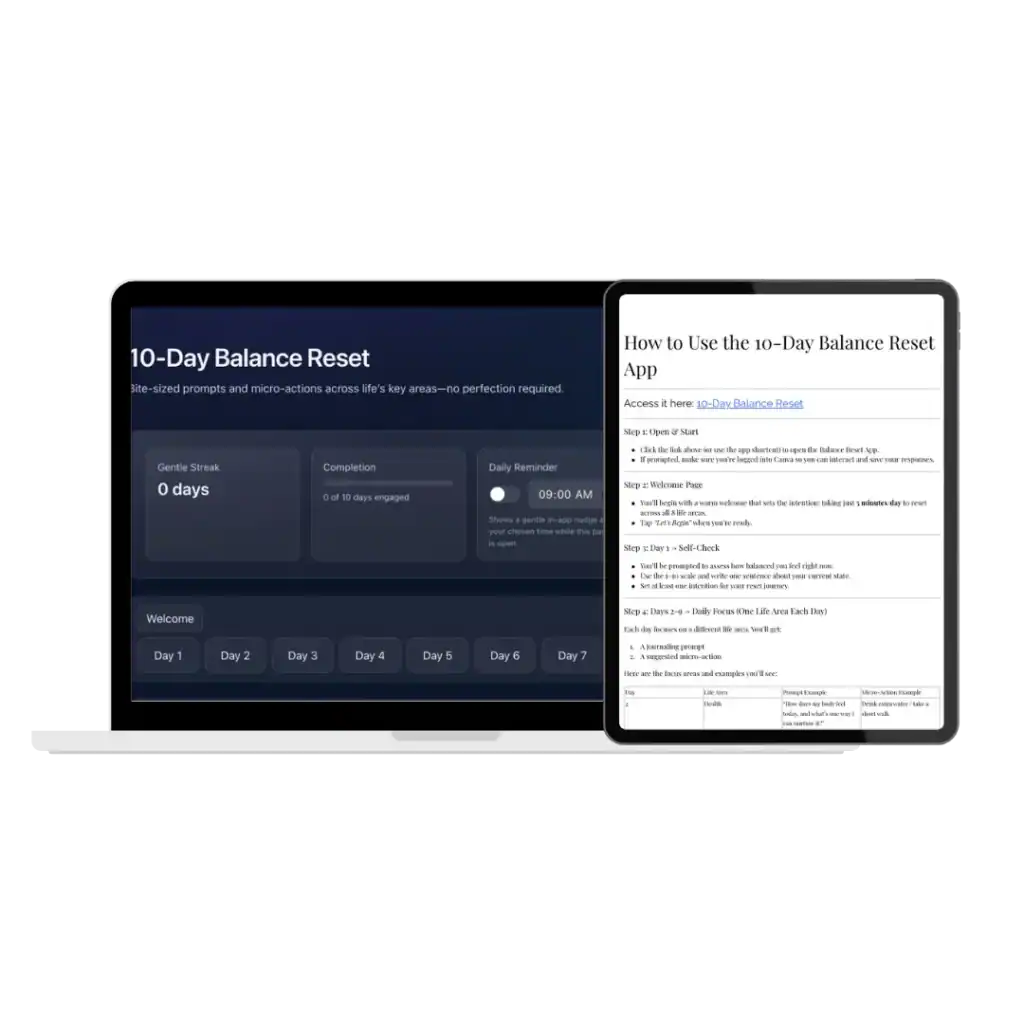
10-Day Balance Reset
- 10 days, 8 life areas → A simple reset to restore balance.
- Daily journaling prompt + micro-action (5 minutes or less).
- Covers health, career, finances, relationships, personal growth, spirituality, joy, and environment.
- Designed to bring clarity, calm, and intentional living.
The Energy Audit: Your Life Design Tool
One of the core tools inside Energy Design is the Energy Audit, a 3-layer system that helps you understand your capacity clearly enough to design around it.
The original version appeared in the DWJ video on Energy vs. Motivation, where you reflected on what filled and drained you during the week.
That version helps you notice patterns.
The Life by Design version helps you build systems.
Here are the three layers:

Layer 1: Micro Energy Checks (Real-Time Awareness)
Throughout your day, pause and ask:
- “Where is my energy right now?”
- “Do I need rest or movement?”
- “Is my brain tired or overwhelmed?”
- “What would help me reset, stillness or stimulation?”
This practice is powerful because sometimes the “exhaustion” you feel is actually stagnation, not depletion.
A two-minute movement break,
a stretch,
a change of scenery,
a glass of water,
or five minutes of sunlight
…can shift your entire system.
Micro-checks prevent burnout before it builds.
Layer 2: Weekly Energy Audit (Pattern Awareness)
Once per week, ideally the same day write down:
- What restored your energy
- What drained your energy
- Where you felt resistance
- Where you felt flow
- What you avoided
- What came easily
This becomes your personal energy data.
After a few weeks of doing this, you’ll begin to notice patterns:
- Certain tasks drain you every week
- Certain people or environments lower your energy
- Certain habits or rituals consistently help you reset
- Certain days require more recovery time
This layer shows you the truth of your lived experience without judgment, shame, or self-criticism.
Layer 3: Life by Design Energy Audit (Systems Awareness)
This is where everything comes together.
With your patterns in front of you, ask:
- “Where are the leaks?”
- “Which drains are predictable?”
- “How can I design boundaries that protect my capacity?”
- “What rhythms help me recover with the least effort?”
- “What support systems do I need consistently — not occasionally?”
This turns the Energy Audit into a design tool, not just a reflection exercise.
You’re not trying to eliminate every drain.
You’re creating small systems that make life easier to sustain:
- Putting high-energy tasks inside your natural energy window
- Adding tiny rituals that help you reset
- Reducing unnecessary mental load
- Protecting your best energy from non-essential demands
This is how your energy becomes intentional, not accidental.
Designing Rhythms That Match Your Real Life
Once you understand your energy patterns, you can start designing rhythms that fit your natural flow.

Ask yourself:
1. When do I naturally have more energy?
Morning? Afternoon? Evening?
This is your “energy window.”
2. What helps me start grounded?
A prayer?
Two minutes of silence?
Journaling one sentence?
Opening the blinds?
Making your bed?
Keep it tiny. Keep it real.
3. Where does my energy dip?
Late afternoons?
After social interaction?
Before bed?
After work?
These dips help you decide where to place breaks, boundaries, or resets.
4. What simple boundary would protect my capacity?
This isn’t about saying “no” to everything.
It’s about saying “yes” to what keeps you stable.
Energy Design is not perfection.
It’s alignment — a daily rhythm that makes your life feel more possible.
What’s Coming Inside DWJ Life by Design
Energy Design is one of the eight life areas inside DWJ Life by Design™, and inside the membership we’re going even deeper:
- Personal energy audits
- Recovery rhythms
- Systems that match your season
- Patterns that help you stay stable during demanding weeks
- Digital wellness tools that support capacity, clarity, and flow
If you want early access to the full Energy Design system, the waitlist is open.
Key Takeaways
I know what it feels like to run on empty and call it “just a busy season.”
If that’s you right now, start with awareness , not guilt.
Here’s what matters most:
- Energy Design helps you see where your energy actually goes.
- Self-care isn’t the fix when your system is overloaded — design is.
- The three-layer Energy Audit shows your patterns, leaks, and rhythms.
- Alignment beats perfection — build rhythms that match your real life.
- Small boundaries protect big capacity.
If you take one thing with you, let it be this:
You don’t rise to the level of your motivation, you rise to the level of your design.
Design your energy, not your burnout.

If your’re ready to design capacity, not chaos, join the waitlist for DWJ LIfe by Design™, where we turn Energy Design into a system you can live by.