
You’re not selfish. You’re not mean. You’re not failing.
You’re just tired, and you need space to breathe.
Saying no guilt-free is a radical act of self-love, especially for Black women who’ve been conditioned to carry everything and everyone. You’ve probably been praised for being dependable, nurturing, and the “strong one.” But baby, what about you?
In this post, we’re naming the guilt, unlearning the martyr mindset, and giving you practical tools to protect your peace, without apology.
Why Saying No Feels So Damn Hard
Let’s be real: many of us were raised to believe our worth is tied to how useful we are to others. Saying yes became the default because:
- You didn’t want to seem “difficult”
- You feared being labeled angry, cold, or ungrateful
- You were trying to keep the peace (even at your own expense)
But overextending yourself doesn’t make you a good person, it makes you exhausted. And sis, exhaustion is not your calling.
“You don’t have to set yourself on fire to keep other people warm.”
Free Download:
Want to say no without overthinking it?
Grab your FREE “5 Scripts for Saying No” PDF — ready-to-use responses for every situation.
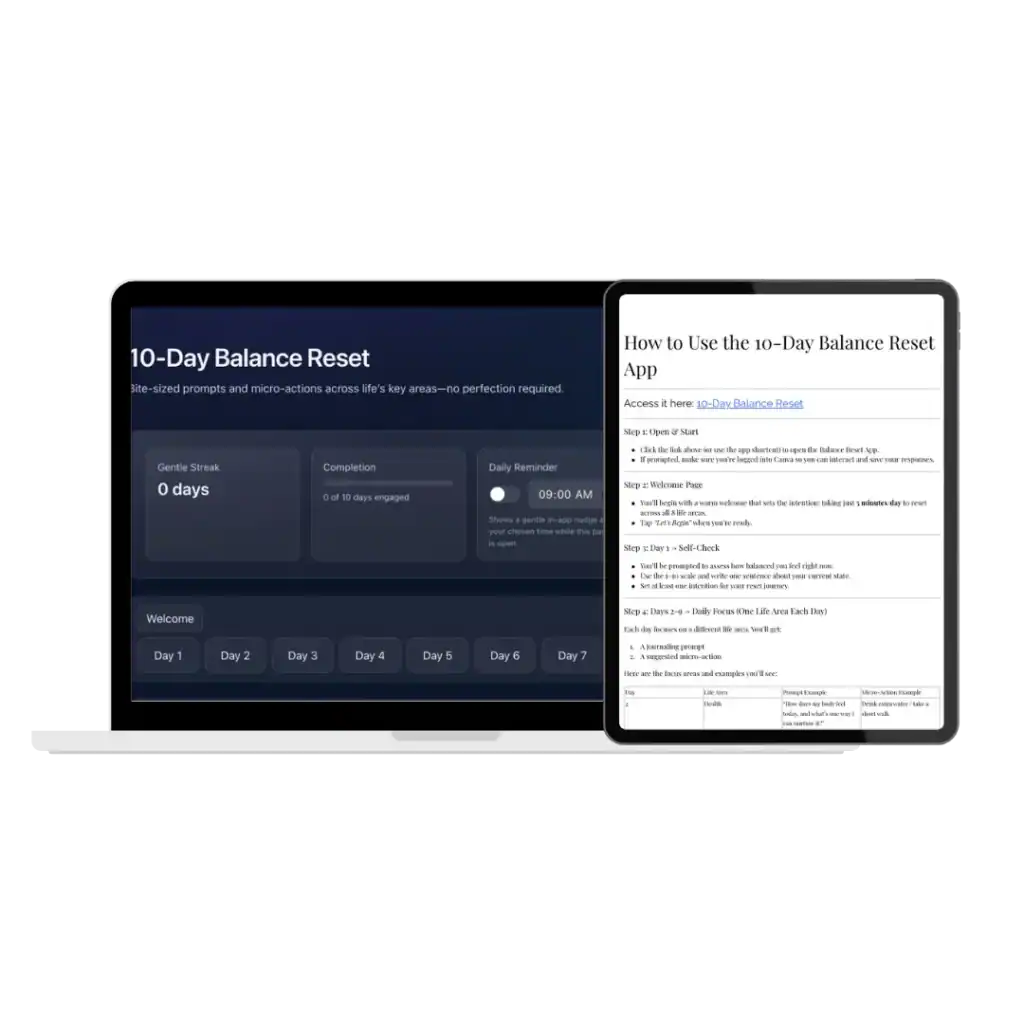
10-Day Balance Reset
- 10 days, 8 life areas → A simple reset to restore balance.
- Daily journaling prompt + micro-action (5 minutes or less).
- Covers health, career, finances, relationships, personal growth, spirituality, joy, and environment.
- Designed to bring clarity, calm, and intentional living.
Boundaries Are a Love Language
Saying no guilt-free isn’t about shutting people out; it’s about letting yourself in. Every no is really a yes to something deeper:
- No to toxic friendships = yes to emotional peace
- No to overcommitting = yes to rest and joy
- No to people-pleasing = yes to authentic living

The Guilt Myth: You’re Not a Bad Person
Let’s dismantle the guilt head-on. Guilt is a natural emotional response, but not always a true one. Ask yourself:
- Am I guilty because I’ve harmed someone?
- Or am I guilty because I’ve challenged someone’s expectations of me?
When the answer is the latter, that guilt is not yours to hold. You’ve simply decided to center your well-being. And that’s more than okay, it’s necessary.
Mantra for guilt-heavy days: I’m allowed to protect my energy. I’m allowed to choose myself.
4 Ways to Start Saying No Guilt-Free

1. Pause Before You Commit
It’s okay to say, “Let me get back to you.”
You don’t have to respond instantly. This small pause gives you the power to reflect instead of react.
Try saying: “I need a little time to think that over. I’ll circle back soon.”
Want more language? Boundary expert Nedra Glover Tawwab’s Set Boundaries, Find Peace is packed with real-world scripts.
2. Start with Soft No’s if You’re New
If a hard no feels scary at first, begin with soft boundaries.
These phrases give you space while still being clear:
- “I don’t have the capacity for that right now.”
- “That doesn’t align with my current priorities.”
- “I appreciate you thinking of me, but I’ll pass this time.”
3. Release the Responsibility for Others’ Reactions
You’re not responsible for how someone feels about your boundaries. Period.
You’re responsible for communicating with respect, not managing their discomfort.
If that feels radical, it is. Black women have long been conditioned to hold space for everyone else, even when we’re empty.
That’s why resources like The Nap Ministry matter. Their message? Rest is resistance. Rest is power. Rest is your right.
And remember: “No” can be a full sentence. Rest can be your reason, even if you don’t say it out loud. Boundaries aren’t walls, they’re doors. And girl, you get to decide who walks through.
4. Use Tools to Strengthen Your Voice
Speaking up gets easier with practice. Use:
- Voice notes
- Journal entries (pen + paper or AI-powered prompts that help you role-play “no” moments)
- Affirmation cards taped where you’ll see them daily
These small practices strengthen your voice before you’re in the moment.
What Saying No Guilt-Free Looks Like IRL
Here’s how it might show up in real life:
| Situation | Guilt-Free Response |
|---|---|
| A friend wants to vent again, but you’re drained. | “I love you, but I don’t have the emotional space for this right now.” |
| A colleague asks you to take on extra work, again. | “I’m at capacity this week. I won’t be able to take that on.” |
| A family member expects you to show up for every event. | “I won’t make it this time, but I’m sending love.” |
You don’t need to overexplain or defend yourself. Clarity is kindness, for you and them.
A Word on Culture, Boundaries & Black Women
Many of us were taught to keep the family running, hold everyone down, and never “disrespect” our elders or bosses. But honoring yourself is not disrespect, it’s divine alignment.
Black women deserve boundaries, too.
You deserve rest, softness, and space to simply be.
Saying no is not betrayal. It’s liberation.
No is a Complete Sentence
You don’t owe explanations. You don’t owe everyone access to your time, energy, or heart. Saying no guilt-free is a skill, and a right, you can reclaim one moment at a time.
You are allowed to:
- Prioritize your peace
- Change your mind
- Set new boundaries
- Let people down and still be a good person
This is your healing. This is your permission. This is your power.
Your Turn:
When was the last time you said yes when you really meant no? What would it have looked like to choose yourself instead?
Pin This for Later Inspiration
Sis, this journey is a process. Save these reminders for when you need courage and clarity.


Share Your Thoughts