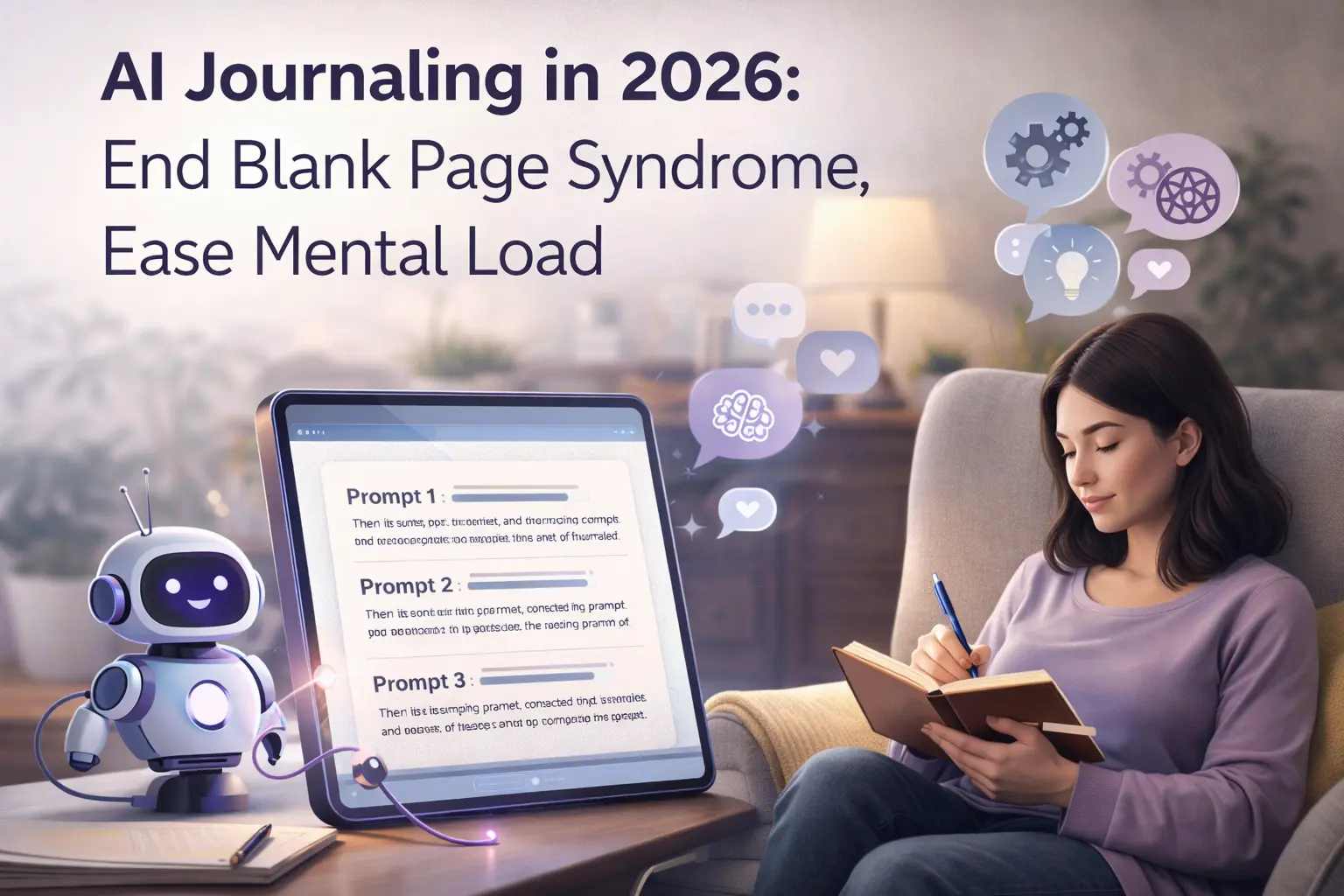
AI journaling changes what happens when you open your journal, stare at the page, and feel your mind go blank. If that happens often, you’re not bad at journaling, you’re dealing with blank page syndrome.
For many women carrying the mental load at home, at work, and everywhere in between, reflection can feel like one more task. The good news is that AI journaling is changing how you begin, making it easier to keep up with, and more useful once you do.
Why journaling feels so hard for so many women
A common problem in journaling feels small on the surface but has a big effect over time. You want to reflect. You want to write about your day, your stress, your feelings, or the stuff that keeps looping in your head. Then you see an empty page and shut the notebook.
That stop-start pattern matters because it keeps you from checking in with yourself. When life is already full, the page can feel like one more demand. Instead of helping, it freezes you.
This is the heart of blank page syndrome. It isn’t laziness, and it doesn’t mean journaling isn’t for you. In many cases, it means the old setup asked too much at the wrong time. It expected you to sit down, gather your thoughts, remember the whole day, and turn it into meaning on command.
For women managing invisible labor, that can feel impossible. Your brain is already tracking appointments, meals, deadlines, moods, logistics, texts, and everyone else’s needs. No wonder a blank page can feel like a wall.

A few signs may look familiar:
- You open a journal and close it without writing.
- You wait until the end of the day, then can’t remember what mattered.
- You try for a few days, then stop because it feels forced.
That old friction is exactly why AI journaling is getting attention. As some newer AI journaling tools for mental wellness show, the goal is not to replace reflection. It’s to lower the barrier that keeps reflection from happening at all.
Your journal is no longer only a notebook
The biggest shift is simple. A journal doesn’t have to be a blank notebook anymore.
Now it can pull together different parts of your day, not only your written thoughts. That may include voice notes, movement data, sleep patterns, calendar context, or even short videos. Instead of asking you to build the whole story from scratch, the tool can work with the pieces you already created while living your life.
Here is the shift in plain terms:
| Old journaling | AI-supported journaling |
|---|---|
| Start with a blank page | Start with prompts, context, or captured inputs |
| Mostly text only | Text, voice, sleep, steps, calendar, video |
| End-of-day recall | Reflection can happen in the moment |
| You spot patterns alone | The system can help surface patterns |
| Focus on what happened | More support for understanding why it mattered |
That doesn’t mean every journal needs every input. It means reflection no longer has to begin from zero.

This matters for mental load because your brain doesn’t have to hold every detail until you sit down to write. You can speak a thought into your phone. You can notice a shift in energy after a meeting. You can let your journal gather context from the day, then help you reflect on what stands out.
Instead of being left alone with an empty page, you get a starting point. That changes the whole experience.
The goal isn’t more tracking for the sake of tracking. The goal is less pressure on your brain, and more clarity about your life.
Just-in-time reflection works better than end-of-day recall
Traditional journaling often happens at night. You sit down and try to replay the day from memory. Sometimes that works. Often it doesn’t.
By the end of the day, the details are blurry. Your feelings may have changed. The hard meeting from 10 a.m. might still be affecting you, but the edge of it is gone. You remember the event, but not the truth of how it landed.
That is where just-in-time reflection comes in.
Instead of waiting until later, AI can prompt reflection closer to the moment that matters. If something stressful happens, the system can nudge you while the feeling is still fresh. If your energy dips after a certain task, it can ask about it then, not twelve hours later.
This point is especially strong: AI journaling helps you think right when you need it most.
A simple version of that process looks like this:
- Something notable happens, like a rough meeting or a tense exchange.
- Your journal captures context, or you quickly log a voice note.
- The AI prompts a reflection while the moment is still clear.
- You respond with more honesty because you’re not trying to reconstruct the feeling from scraps.
This kind of timing can make reflection more useful because it matches real life. It also helps women who don’t have long quiet windows at the end of the day. A short check-in during the day may work better than a long journaling session that never happens.
If you’re curious how this kind of support is being framed more broadly, this guide to AI journaling in 2026 explains how timely prompts can reduce friction and support more consistent self-reflection.
AI can spot patterns you’re too close to see
One of the most powerful ideas in the video is that AI doesn’t only store your thoughts. It can also look across them.
That means it may notice a pattern you miss because you’re living inside it. Maybe your mood drops every Tuesday. Maybe your stress spikes after back-to-back meetings. Maybe you sleep poorly before days when your calendar is overloaded. On your own, those pieces may feel random. Seen together, they can tell a clear story.
A helpful image makes this idea clear: living your life can feel like having your nose pressed against a painting. You see color, motion, and mess, but not the full picture. When you step back, you can finally make sense of what you’re looking at.
AI can offer that step back.

This doesn’t mean the system knows you better than you know yourself. It means it can notice repeated signals across your notes and habits. In other words, it helps you see what daily survival mode tends to hide.
That bigger view can help you:
- connect certain feelings to certain days or routines
- notice habits that drain you
- spot triggers that keep repeating
- make changes based on patterns instead of guesses
A thoughtful overview of AI journaling and self-reflection makes a similar point. When a journal can reflect patterns back to you, the writing becomes more than a record. It becomes feedback.
For women carrying mental load, this matters because stress often shows up as background noise. You feel off, but you don’t know why. Pattern spotting gives shape to the fog.
The real shift is moving from what happened to why it matters
Old-style journaling often stops at description. You write down what happened, who said what, how tired you felt, or what went wrong. There is value in that. Getting the day out of your head can bring relief.
Still, recording events is not the same as understanding them.
There’s a deeper goal underneath all of this: reflection should help you move from the what to the why. Why did that meeting stick with you? Why do certain tasks leave you resentful? Why does one kind of day feel heavy while another feels calm, even when both are busy?
That is where AI can speed things up. It can ask follow-up questions, connect current feelings to past patterns, and help you get to meaning faster. Instead of staying on the surface, you move toward insight.
You might begin with, “I felt off after work.”
Then the deeper layer becomes, “I feel off every time I say yes to one more task when I’m already overloaded.”
That second sentence is where change starts.
A good journal records your life. A better journal helps you understand it.
For many women, this shift is especially important because mental load is often invisible. You may know you’re tired, but not fully see the hidden work creating that tiredness. Reflection that reaches the why can make invisible labor visible, at least to you. That makes it easier to name, adjust, and protect your energy.
AI should be your mirror, not your judge
Privacy is the part many people hesitate over first, and for good reason. The thought of a computer reading private thoughts can feel uncomfortable.
Remember, AI can be helpful when used ethically and without sharing full personal identifying information. That distinction matters. A reflective tool should support your thinking, not expose your life.
AI is a mirror, not a judge.

A mirror doesn’t tell you whether you’re good or bad. It doesn’t punish you for what it sees. It reflects back what is already there. In this case, the tool can reflect your words, patterns, and habits in a clearer form. You still decide what they mean. You still choose what to do next.
That matters because reflection needs safety. If a tool feels harsh, intrusive, or overly certain, people pull away. If it feels calm and useful, people can stay honest.
In practice, a mirror-like AI might:
- summarize what you’ve been feeling lately
- point out repeated stress patterns
- ask a gentle question you hadn’t thought to ask
- help you name what has been hard to carry
That kind of support fits the mission behind Digital Wellness Journal, where AI and journaling are used together to help reduce mental load. The point is not to hand your life over to a system. The point is to see yourself more clearly with less pressure.
What AI journaling can do right now in 2026
The future described here isn’t far-off or theoretical. In this framing, it’s already part of everyday life in 2026.
That includes simple, practical tools that fit into everyday life. You can talk into your phone and have the words transcribed. You can connect information like sleep, steps, or calendar events. You can record a short video when writing feels like too much. Then the system can respond with prompts based on what it notices.
Those options matter because different days call for different forms of reflection. Some days you can write. Some days you need to talk. Some days you only have a minute. A flexible journal meets you where you are.
Here are a few examples of what that can look like now:
- Voice-to-text for quick thoughts on the go
- prompts based on your sleep, activity, or schedule
- short video check-ins for emotional processing
- follow-up questions tied to your recent patterns
If blank pages have always stopped you, tools like an Journal Prompt Generator below for journaling show how much easier it can be to begin when the first question is already there.
Journal Prompt Generator
Choose how you feel, what you want to focus on, and where you want to go next. Then generate 3 prompts to help you reflect with intention.
The key point is not that every tool will fit every person. It is that reflection no longer has to rely on one narrow method. You can build a practice that supports the way your life already works.
Three takeaways that change journaling for good
There are three ideas that tie everything together.
First, the blank page does not have to win anymore. AI can help you start before overthinking takes over. That alone can bring relief if getting started has always been the hardest part.
Second, AI works best as a friendly mirror. It should help you see, not shame you. Clear reflection is useful. Judgment is not.
Third, the best use of AI journaling is not only logging events. It is helping you understand why those events matter, what patterns they connect to, and what they might be showing you about your needs.
For women trying to reduce mental load, those three ideas matter because they turn journaling into support instead of homework. The practice becomes lighter, more responsive, and more grounded in real life.
Build a life that feels less loaded
Your invitation to keep going beyond the video. Join the community, The Prompted Life, centers on using AI and journaling together to reduce stress and build a life that feels more doable and more honest.
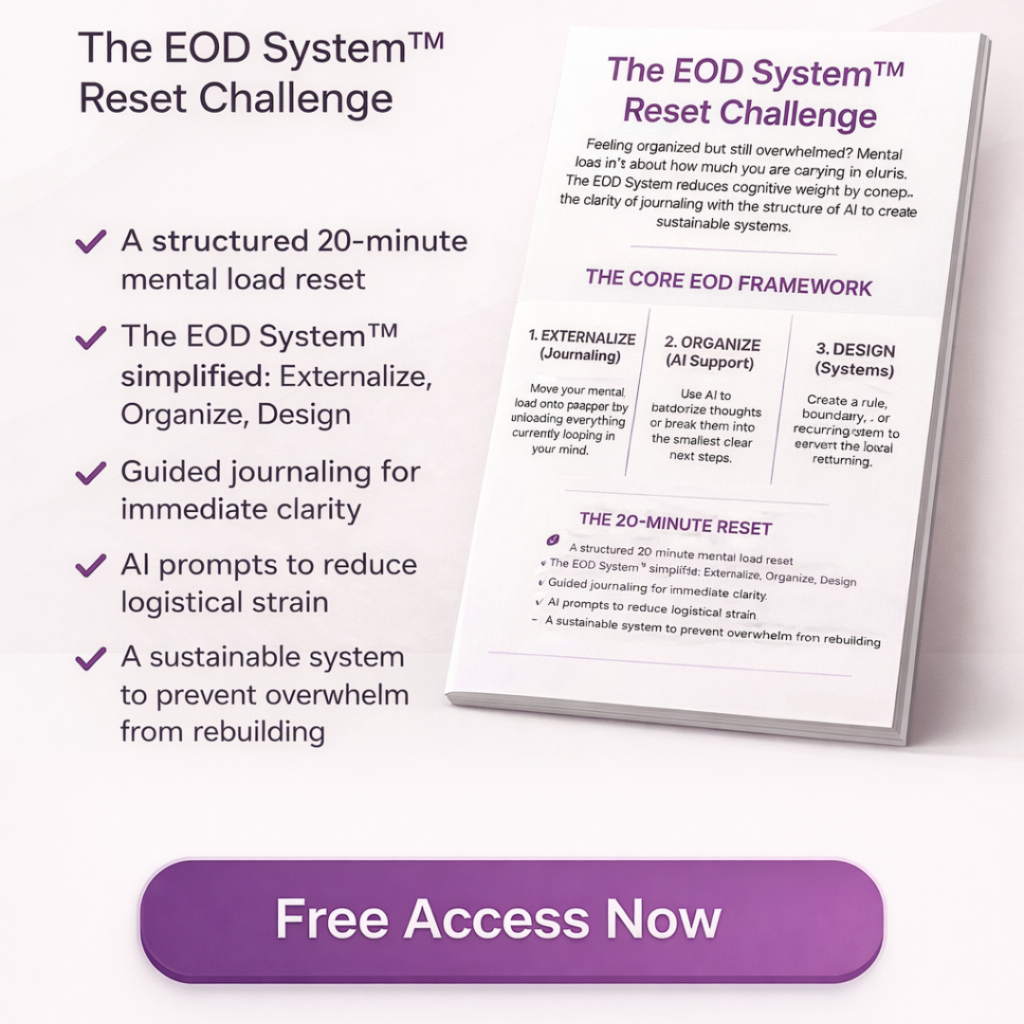
If you want a simple place to start, the EOD System™ Reset Challenge offers a 20-minute guided way to work through the process.

The blank page used to stop the process before it began. Now, AI journaling can help turn that stuck moment into a starting point.
If your brain feels full and your thoughts feel scattered, this may be the shift that makes reflection finally feel possible.
Discover more from Digital Wellness Journal
Subscribe to get the latest posts sent to your email.