

If you’re wondering how to reduce mental load in a way that actually lasts, you need more than a reset or a better to-do list. You can be organized on paper and still feel mentally exhausted by bedtime. Your list is tidy, your calendar looks fine, and yet your brain will not stop running.
That’s invisible mental load. It’s the constant background processing that keeps your life from falling apart, even when nobody sees it.
This is where the EOD System™ helps. It’s not about productivity, it’s about clarity that lasts, because you stop carrying everything in your head.
Table of Contents
The hidden weight you’re carrying (even when you’re “fine”)
Mental load isn’t just the tasks you do. It’s what you’re silently tracking all day long.
It’s anticipating what’s coming, remembering what can’t be forgotten, and mentally rehearsing the next three steps while you’re doing the current one. It’s noticing the toothpaste is low, realizing picture day is Friday, planning dinner while answering emails, and feeling responsible for the emotional temperature in the room.
That’s why you can look capable and still feel scattered inside.
When your brain is crowded, your decisions get messy. You grab the fastest option, not the aligned one. You react, instead of choosing. And if you’re trying to build a Life by Design, rooted in clarity and intention, mental load has to come down first. Then you can design what comes next.
You can’t design your life clearly when your brain is crowded.
Why To-Do Lists Don’t Fix Mental Load (And How to Reduce Mental Load Instead)
Most resets don’t fail because you lack discipline. They fail because they don’t reduce the thinking required to keep the whole machine running.
A to-do list can track actions, but it often leaves the real weight untouched. You still have to decide what matters, when it happens, what it depends on, and what you’re going to sacrifice to make it fit. That decision-making tax hits you all day.
Here’s what usually keeps the mental load loop alive:
- Your list captures tasks, but not the constant anticipating behind them.
- You keep “open tabs” in your mind because nothing is fully processed.
- You do a quick reset, but you don’t build anything that prevents the load from rebuilding next week.
So you end up doing the same cycle again: a burst of effort, a little relief, then the slow creep of overload.
If you want clarity that sticks, you need a simple order of operations. That’s what EOD gives you.
Mental load isn’t about what you’re doing, it’s about what you’re carrying.
The EOD System™: Externalize, Organize, Design (in that order)
EOD is a repeatable three-step framework:
Externalize so the invisible becomes visible.
Organize so the visible becomes clear.
Design so the clear becomes sustainable.
This order matters. If you skip a step, you might feel better for a day, but the clarity won’t hold.
There’s also a quiet emotional benefit here. When you externalize, you stop gaslighting yourself. You can see the truth of what you’ve been managing, and that alone brings relief.
If you’re familiar with the DWJ journaling cycle (Awareness, Emotions and Needs, Alignment, Action), EOD fits naturally. Externalize builds awareness. Organize supports alignment. Design makes action easier to repeat without burning you out.
Step 1: Externalize (strategic journaling, not pretty journaling)
Externalize means you move the mental swirl out of your head and into a structured reflection.
This is where journaling matters, but not aesthetic journaling. Messy is fine. Fast is fine. The point is to get it out where you can see it.
When the mental load stays in your mind, it feels endless. Once it’s on paper (or in a note), it becomes a real, countable thing. That’s when relief starts, because you’re no longer trying to remember everything at once.
Use this one journaling prompt to begin:
Journaling prompt:
What am I tired of thinking about lately, even if it sounds small?
Write your answer as plainly as you can. Then add a few lines underneath:
- What keeps popping back into your head?
- What are you afraid you’ll forget?
- What feels like it has “no owner” but still lands on you?
You’re not trying to solve it yet. You’re making it visible, so you can stop carrying it in your nervous system.
If you want a deeper baseline on what’s draining you across your whole life (not just one problem), use a Personal Life Evalutation Assessment to see which areas are quietly pulling your energy.
This is the first real step in how to reduce mental load, because your brain can’t release what it’s still trying to store.
Step 2: Organize (use AI as a thinking partner, not a boss)
Once your mental load is visible, it needs structure. Otherwise it becomes a long list that still feels heavy.
This is where AI can help, because it can sort, group, and simplify faster than your tired brain can. Think of it like a thinking partner that handles logistics.
The rule is simple: AI handles the structure, you handle the alignment.
It doesn’t replace your judgment. It reduces the strain of organizing the mess.
Here’s one role-based AI prompt you can copy and use. Keep it honest and specific:
Role-based AI prompt:
You are my mental load assistant. I’m a multi-role woman managing home, work, and care tasks. I will paste a list of everything I’m carrying. Please (1) group items into 4 to 6 categories, (2) highlight what is time-sensitive this week, (3) identify any recurring tasks I can turn into a routine, and (4) suggest the simplest next step for each category. Keep it practical and kind.
After you get the output, you decide what stays, what goes, and what actually matters in this season. That’s alignment.
If you’ve been running on low capacity, organizing alone might not be enough. In that case, pair this with energy design rhythms so your plan matches your real life, not your fantasy week.
Step 3: Design (so the mental load doesn’t rebuild next week)
Design is where sustainability happens.
This step is not about building a perfect system. It’s about creating one small boundary or ritual that stops the same problem from reappearing on repeat.
Design can look like:
- a weekly planning ritual you can actually keep
- a boundary around your calendar (especially your best energy hours)
- a recurring decision you automate so you don’t have to keep re-deciding it
The point is simple: the same life, the same responsibilities, just less mental strain.
If you tend to say yes too fast, your design step may need a boundary more than a routine. In that case, practice saying no guilt-free so your systems have room to work.
A real example: ending the “what’s for dinner?” cycle
Meal planning is a perfect mental load example because it seems small, but it hits every day. The question “What’s for dinner?” can become one of the hardest decisions in your whole day, especially when you’re already tired.
Here’s how EOD looks in real life.
Externalize: Write the real sentence.
“I’m tired of thinking about meals.”
That one line tells the truth. It also shows you this isn’t a character flaw. It’s a decision burden.
Organize: Let AI handle the structure.
You can ask AI for a 5-day dinner plan based on what you already have in the fridge and pantry. You can also ask it to reuse ingredients to cut waste and reduce extra store runs.
Design: Put a tiny system in place.
Pick a simple Sunday ritual, even 15 minutes. Choose dinners, check what you’re missing, and make one short list. Same meals, different feeling.
You’re not becoming a new person. You’re reducing the background processing that steals your peace.
What Changes When You Practice How to Reduce Mental Load Consistently
When you practice EOD, you’ll notice two shifts, one emotional and one mental.
Emotionally, you move from overwhelm, to relief, to ease.
Mentally, you move from clutter, to structure, to structured clarity.
Here’s the contrast in a quick scan:
| Before EOD | After EOD |
|---|---|
| Your brain runs a constant mental checklist | Your tasks live outside your head |
| Decisions feel heavy and never-ending | Decisions get simpler and clearer |
| You feel behind even when you’re doing a lot | You feel steadier doing the same life |
| You reset, then crash, then repeat | You build small systems that hold you |
This is why EOD isn’t about doing more. It’s about thinking more clearly, so you can live with intention again.
One small action you can take today (so you feel it, not just read it)
Choose one mental load that keeps looping. Not your whole life, just one loop.
Next, do this one visible action step:
Write that load on paper, then tape it somewhere you’ll see it (or pin it at the top of your notes app). Title it: “This is what I’m carrying.”
That’s it.
Visibility is the first form of support. Once it’s visible, you can organize it. Once it’s organized, you can design around it.
If you want a guided way to do this quickly, use the EOD System™ Reset Challenge to walk through Externalize, Organize, and Design in about 20 minutes.
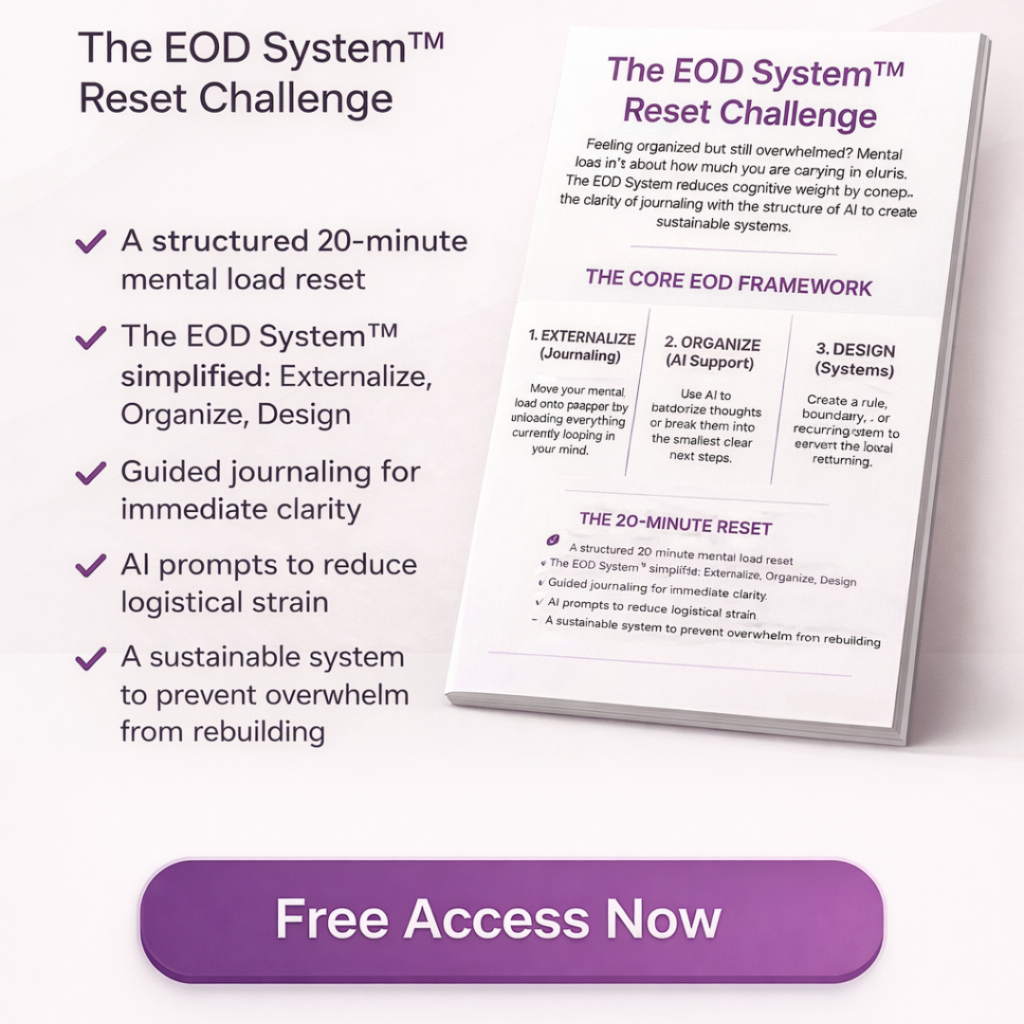
You can also practice the EOD rhythm weekly inside The Prompted Life community, where you build clarity one system at a time, with journaling and AI support.
If you want to know how to reduce mental load starting today, choose one looping stressor and run it through EOD in this order.
A Life Less Loaded
A life with less mental load doesn’t mean a life with no responsibility. It means the weight has a place to go, decisions get clearer, and your brain gets to rest more often.
Start with one loop, one page, one simple system. Then repeat.
Your takeaway: clarity comes from structure, not pressure. Keep going, you’re not behind, you’re just carrying a lot.
Discover more from Digital Wellness Journal
Subscribe to get the latest posts sent to your email.