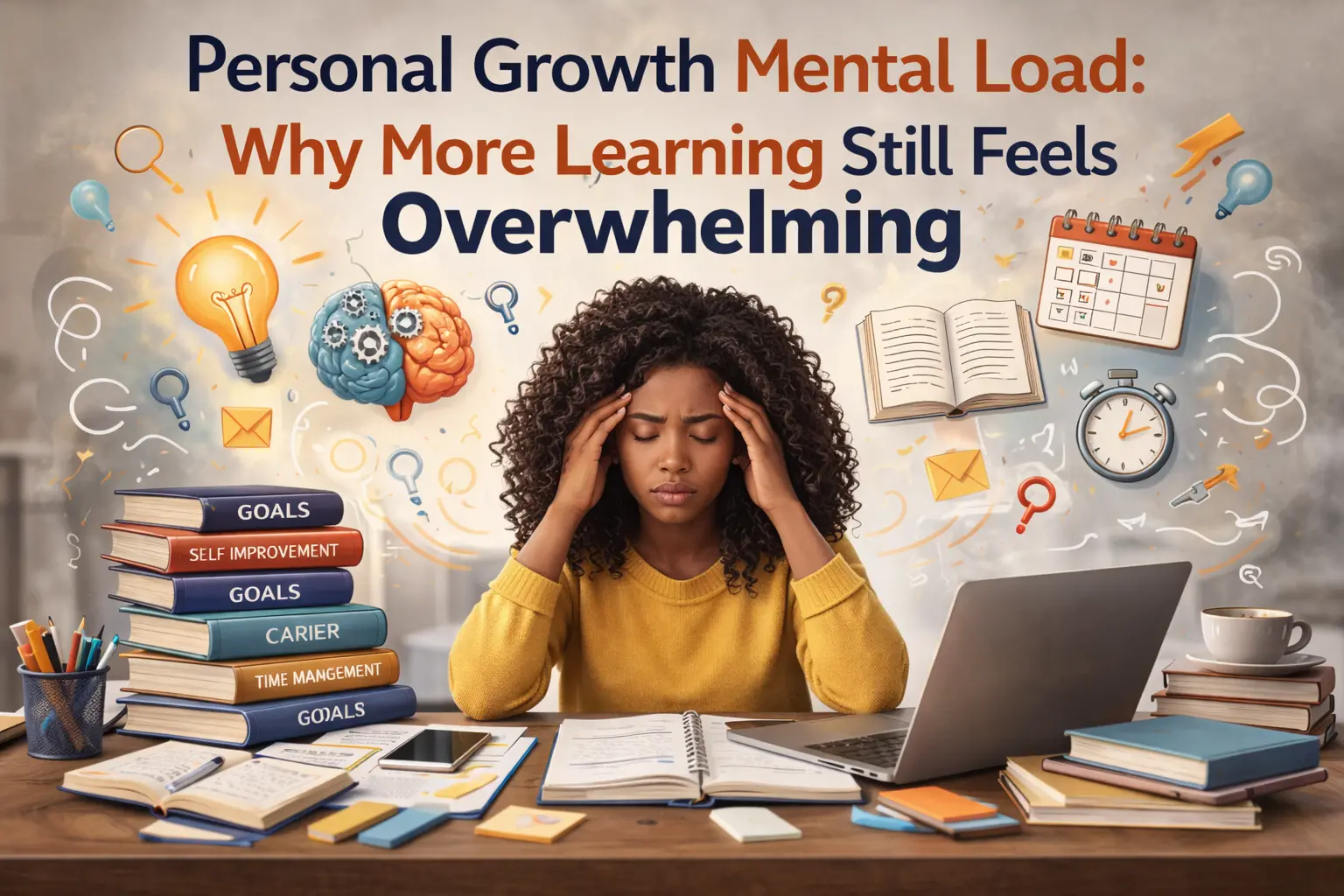
You can be serious about growth and still feel stuck. You read the books, save the posts, buy the courses, and take the notes. Yet your life doesn’t feel lighter, clearer, or easier to live.
That heavy in-between feeling often has a name, personal growth mental load. It happens when learning becomes one more thing you have to manage in your head. If you’ve been carrying insight without real change, this is the shift that helps you finally make what you know work in real life.
What personal growth mental load actually is
Personal growth mental load is the invisible work of managing your own self-development. You’re not just learning. You’re also tracking what you learned, trying to apply it, judging yourself when you don’t, and holding the gap between who you are now and who you think you should be by this point.
That’s why growth can start to feel oddly heavy.
Instead of helping you feel supported, it can start to feel like a private performance. You keep score. You replay what you haven’t done. You carry guilt for money spent, time invested, and ideas left unused.
It often sounds like this:
- You finished the book, but you didn’t change the habit.
- You started the routine, then dropped it.
- You bought the course, but never made it past module three.
When growth turns into a scorecard, it stops feeling supportive and starts feeling like pressure.
If this hits close to home, you’re not lazy and you’re not failing. You’re dealing with a form of mental load, the same kind of invisible weight described in this system to manage mental load overwhelm. The problem isn’t that you care too much about your growth. The problem is that you’ve been trying to carry all of it internally.
Why more learning can leave you more overwhelmed
The consumption-action gap gets wider
You live in a time with endless self-help content. There’s always another podcast episode, newsletter, framework, or class promising a better version of you. So you keep learning because you care, and because part of you hopes the next thing will finally click.
Still, consuming and integrating are not the same thing.
Here’s what that gap often looks like:
| You consume | But nothing changes yet |
|---|---|
| A book on habits | No habit becomes part of your week |
| A podcast on boundaries | You still say yes when you want to say no |
| A mindset course | Your self-talk sounds the same under stress |
The wider that gap gets, the heavier your growth load feels. You’re not just holding information. You’re also holding unfinished change.
The self-improvement treadmill never really ends
A lot of growth culture quietly teaches one message, you’re not enough yet. So you keep pushing. You keep trying to optimize. You keep telling yourself that one more tool, one more method, or one more breakthrough will finally make you feel settled.
That message lands hard when you’re already a high-functioning woman who takes responsibility seriously.
Because of that, growth stops feeling spacious. It starts feeling like another standard to meet. You compare yourself to the version of you that should already be more disciplined, more calm, more consistent, or more evolved. That comparison is tiring all by itself.
Most advice tells you what to do, not how to live it
This is the practical piece. Many personal growth resources tell you what matters, but very few show you how to fit it into a full life with work, people, errands, caregiving, and low energy.
So the cycle repeats. You learn something helpful. You feel inspired. You make a plan. Then life gets loud, the plan falls apart, and you take that personally.
But the issue usually isn’t effort. It’s integration.
The simple shift: stop tracking growth, start integrating it
What helps is not more motivation. What helps is a simple system.
At Digital Wellness Journal, that system is the EOD System for mental overload, which stands for Externalize, Organize, and Design. It works because it takes your growth goals out of your head, helps you sort what matters now, and turns insight into something repeatable.
This is also a Life by Design shift. Instead of treating your whole life like one giant self-improvement project, you choose one area that would actually make your daily life feel better. That’s a very different posture. It’s calmer, more honest, and much easier to sustain.
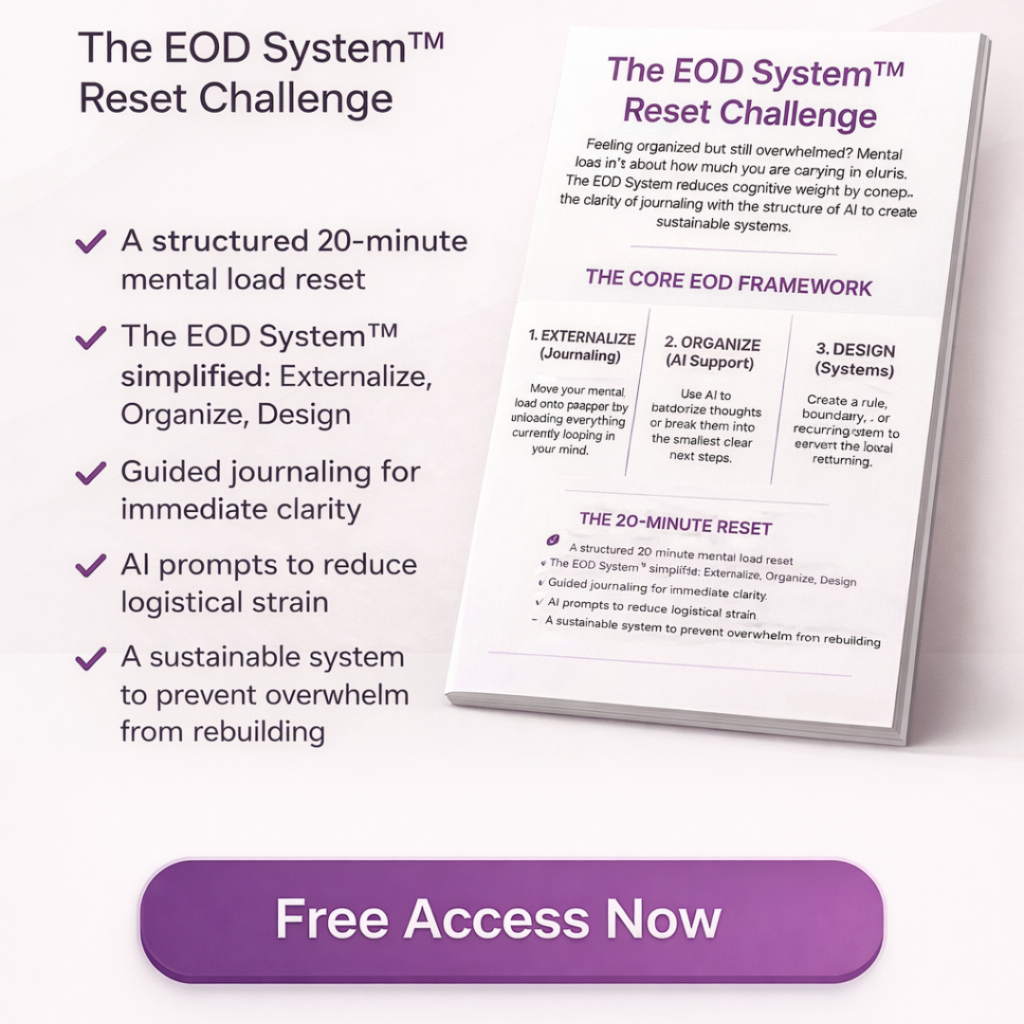
Use the EOD system to make one change stick
Externalize what you’ve been carrying
Start with a growth brain dump. Write down the books you mean to finish, the courses you bought, the habits you started and dropped, the goals sitting half-done, and the versions of yourself you feel pressure to become.
Then pause and ask one honest question.
What am I actually trying to change, and why does it matter to me?
That prompt matters because your answer should come from your real life, not from somebody else’s content calendar.

Organize the noise with AI
Once your thoughts are out, let AI help you sort them. You don’t need it to tell you who to become. You need it to help you focus.
Use a role-based prompt like this:
You are my calm planning partner. I’m a busy professional woman carrying too many personal growth goals at once. Here is my brain dump: [paste your list]. Help me choose the one growth area that would make daily life feel easier right now, create a realistic 15-minute daily practice, show me what I can let go of for now, and give me a simple monthly review.
That kind of prompt helps you narrow the list without spinning longer.

Design a system that fits your actual life
This is where change gets real. Pick one of these and use it this week.
The One Thing Rule means you focus on one growth area for the next 30 days. Not five. Just one.
The Integration Window means you protect 15 minutes a day for application, not more content. You journal, reflect, practice, or use what you already learned.
The Monthly Growth Review gives you closure. Ask:
- What changed for me this month?
- What am I still consuming but not using?
- What do I want to focus on next?

What this shift looks like in real life
Tamberly shares a version of what many women know well, shelves of books, finished courses, and pages of notes that never changed daily life in the way they were supposed to. The turning point wasn’t new information. It was finally using a system to stay with one thing long enough for it to take root.
You may need that same reframe.
You probably don’t need another book right now. You may need a way to use what’s already sitting in your notes app, on your nightstand, or in your saved folder. When you stop jumping from insight to insight, you give one change the chance to become part of you.
Start tonight with one visible step
Take one sticky note or one notebook page and write this at the top: “My one thing for this month.”
Then fill in the blank.
That’s your small visible action step. Put it where you can see it tomorrow.
If your mind gets loud at night while you’re trying to sort all of this out, a gentle nighttime reset ritual can help you close the day with less mental noise.
And if you want ongoing support using journaling and AI to reduce the load you carry, you can explore The Prompted Life community. It’s a soft next step if you want structure without more pressure.
Let one thing count
You don’t need to prove that you want to grow. You already have. What you need now is integration, not more intake.
Pick one change. Give it a place in your real life. Then let that be enough for this season.

Share Your Thoughts