

You know your child’s shoe size right now. You know the next dentist appointment. You know which shirt is suddenly the only “acceptable” one, and which snack can’t go to school because of classroom allergies. Meanwhile, your partner might need to ask you. Again.
That gap isn’t a parenting failure on their part. It’s parenting mental load on yours.
If you’re functioning but tired, this is for you. You’ll see the eight areas where the mental load hides, then you’ll learn a simple way to start sharing it using Tamberly Hamlett’s EOD System (Externalize, Organize, Design). If you’re exhausted from being the default parent, keep reading.
Table of Contents
What parenting mental load really is (and why it drains you)

Parenting mental load is the invisible thinking work that runs before the work. It’s the tracking, scheduling, anticipating, coordinating, and emotional labor that keeps your child’s life steady.
A doctor visit shows it clearly. You notice the cough has lasted three days. You decide if it’s serious. You find an appointment that doesn’t wreck school and work. You fill out forms. You remember current meds. You follow up on the prescription and make sure it gets taken.
Someone else might do the driving, but you made it happen.
The hardest part is that this work is mostly unseen. You rarely get credit for it, yet if you stop, things break. If you want language for that “tired but can’t rest” feeling, this guide on overcoming mental load overwhelm puts words to what you’re living.
The 8 things you’re probably the only one remembering
1) Medical details (and the fact that school calls you). You know the pediatrician’s name and number, the last visit date, the vaccine records, the allergies, and which meds worked (or didn’t). You know what needs to be discussed at the next appointment. When your kid gets sick at school, they call you because you’re the one holding the whole file in your head.
2) School life in real time. Teacher names. Class schedules. Field trip dates. Science projects. Picture day. The school play. Report cards. It’s not just “being involved.” It’s constantly scanning the calendar and the inbox so nothing gets missed, and if it does, it somehow lands on you.
3) Clothing, sizes, and the stuff they outgrow overnight. You know what size they wear right now. You notice the shoes getting tight. You remember winter clothes won’t fit from last year. You track the backpack situation. You also know the favorite shirt is in the wash, and you silently adjust the next morning to avoid a meltdown.
4) Their emotional world (even when they say they’re fine). You know the best friend’s name. You know who they’re struggling with. You notice the “off” mood before they explain it. You can tell when they need a quiet night in instead of a play date. This is constant emotional monitoring, and it’s work even when you don’t talk about it.
5) Activities and logistics. Practices, games, recitals, drop-offs, pick-ups, and the moment registration opens for the next season. You become the family logistics coordinator by default. Then if you miss one practice or forget one game, everyone feels it, including you.
6) Food preferences (plus the emotion tied to feeding). You know what they will and won’t eat. You know the lunch preferences and which snacks to pack. You plan dinners that won’t start a battle. Feeding kids isn’t only nutrition, it’s also managing moods, transitions, and everyone’s last nerve at the end of the day.
7) Future planning that never stops running in the background. You’re thinking ahead: reading progress, tutoring, readiness for the next grade, confidence-building activities, strengths, and support needs. You’re not only parenting today, you’re planning for who they’re becoming. That’s a lot to carry without a place to put it.
8) Being the “default parent” with all the answers. Your kids ask you. Your partner asks you. School calls you. Doctors’ offices call you. You’re the hub. Over time, that role turns into exhaustion, because you’re not just doing tasks. You’re holding the system together.
If everyone has access to you, they don’t have to build access to the information.
Use the EOD System to stop being the only place the info lives
The fix isn’t “try harder.” It’s a structured shift: Externalize, Organize, Design. You’re moving the mental load out of your head and into something shareable.
Externalize: do a 10-minute brain dump tonight

Set a timer for 10 minutes. Write every parenting task you’re tracking, even the tiny ones. Appointments. Permission slips. Shoes. Teacher emails. Birthday party gifts. Medication refills. All of it.
Don’t sort it yet. Don’t make it pretty. The point is simple: as long as it stays in your head, it eats your energy, and nobody else can see it.
Journaling prompt (keep it simple):
What are the three parenting “open tabs” you keep checking in your mind, even when you’re trying to rest?
If nights are when the mental load gets loudest, pair this with a gentler bedtime reset like this nighttime wind down routine so your brain can actually power down.
Organize: let AI sort the pile so you can breathe
Next, paste your brain dump into an AI tool and ask it to categorize, prioritize, and suggest what can be shared, delegated, or automated.
Here’s the exact prompt from Tamberly’s method:
I’m experiencing parenting mental load and need help organizing my tasks. Here’s my brain dump:
[Paste your list here]
Please help me:
- Categorize these tasks by area (medical, school, clothing, social, activities, food, etc.)
- Identify which tasks are urgent vs. important
- Suggest which tasks could be shared with my partner, delegated, or automated
- Recommend one system I could create to reduce this mental load long-term
Format your response in a clear, actionable way.
Role-based AI prompt (so it actually transfers):
You are my co-parenting logistics assistant. Create a one-page “Kid Info Sheet” that includes medical, school, and activity details. Then list what my partner needs to fully own the medical category for the next 30 days, including what info they need and what decisions they can make without me.
If you also want partner language that reduces defensiveness, this article on how to share the parenting mental load can help you frame the conversation around teamwork, not blame.
Design: build one shared system in one area

Pick one category to fix first (medical, school, or activities). Then design a system that makes the information shared by default.
You have a few clean options:
- A shared family calendar with reminders for both of you.
- A shared document with pediatrician info, allergies, meds, school contacts, and schedules.
- A full ownership transfer, where your partner owns one category completely (not “helps,” owns).
Small visible action step (do this today): Put the next two kid-related dates on a shared calendar and add reminders for both of you. That’s it. You’re not rebuilding your life tonight. You’re creating proof that the load can move.
/
Why this matters, even if you’re used to carrying it

Tamberly shares that she carried all of this as a single mom, with no co-parent help. It wasn’t the kind of exhaustion that sleep fixed, because it wasn’t only physical. It was the weight of holding everything in your mind, with no breaks.
That’s the heart of it. The problem isn’t that you’re not capable. The problem is that your brain became the storage unit.
Whether you’re co-parenting or doing it solo, the goal stays the same: stop being the only place the information lives.
One system can change your whole week
When you’re the only one who remembers, you become the bottleneck, and you also become the one who burns out. Start smaller than you want to. Externalize what’s in your head, organize it with support, then design one shared system so it doesn’t rebuild tomorrow.
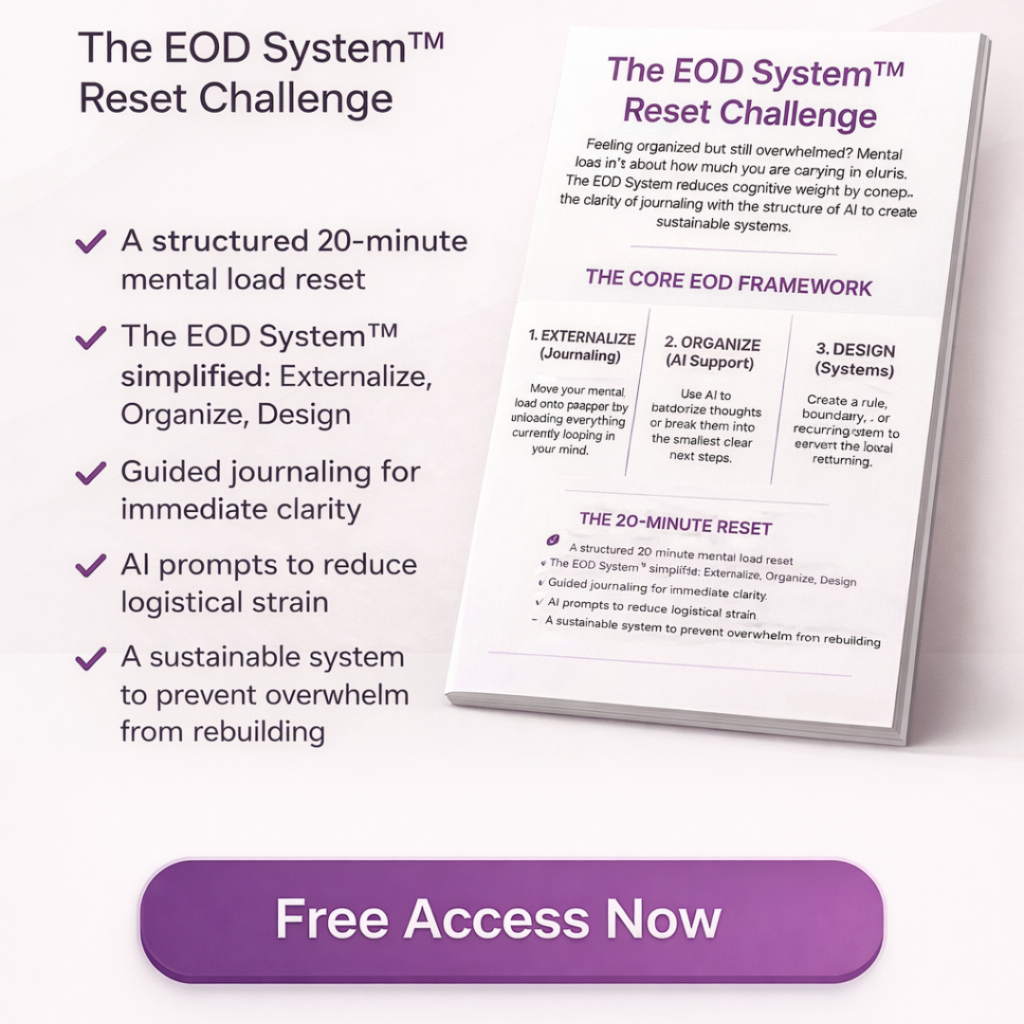
If you want a guided way to do this in one sitting, try the 20-minute EOD Reset Challenge. If you want ongoing weekly practice with journaling and AI, you can also explore The Prompted Life community.
Your one takeaway: you don’t need to carry parenting mental load alone, and you don’t need a perfect plan to start, you just need one place to put the weight down.



Share Your Thoughts