


You can be “off” even when nothing is technically wrong.
You’re not behind, you’re not rushing, you’re not putting out fires, and somehow you still feel heavy. Mentally tired. A little scattered. Like your body is sitting down, but your mind won’t unclench.
That doesn’t mean you’re failing. It usually means you’re carrying mental load that nobody can see, including the people who benefit from it.
That “always-on” exhaustion has a name, and it isn’t laziness
When you feel overwhelmed on a quiet day, it’s easy to turn inward and assume something is wrong with you.
You might ask yourself, “Why can’t I relax?” or “Why do I still feel tense when nothing is happening?” That kind of self-talk can creep in fast, especially when you’re someone others rely on, someone who usually keeps things moving.
Here’s what’s actually happening.
Your body might be resting, but your mind is still working.
Before you try to change anything, it helps to pause and notice what’s true. Not what you think should feel lighter. Not what you wish you were carrying. Just what is actually occupying your mental space right now.
That awareness matters because mental load isn’t just about tasks. It’s about responsibility. It’s about the quiet, ongoing effort of tracking, anticipating, and holding things together in the background of your life.
Once you can clearly see what your mind has been managing, you can start making small, protective choices that reduce pressure. Not by doing more, but by recognizing where your energy is already being spent.
Mental load rarely stays contained in one area. It leaks into rest, relationships, focus, and decision-making. Naming it is often the first moment of relief.
Mental load isn’t “doing,” it’s “holding”
Most people are taught to measure work by what can be seen.
Emails sent. Appointments attended. Errands handled. Tasks crossed off. That’s task work, and it’s real.
But mental load is different. It’s the unseen “thinking work” that keeps life moving. It’s the internal tabs you keep open all day, whether you’re at work, resting, or trying to fall asleep.
Here’s a simple way to separate the two:
| Task Work | Mental Load |
|---|---|
| Visible actions people can notice | Invisible responsibility people assume “just happens” |
| Has a clear start and finish | Rarely feels finished, it just shifts shape |
| Looks productive on the outside | Uses energy quietly, even in stillness |
Mental load drains you because it asks your brain to stay in management mode.
This kind of invisible cognitive labor has been widely documented in research on mental load and cognitive burden.
It’s not just “remember to do the thing.” It’s “remember everything connected to the thing,” including people’s needs, timing, and what might fall apart if you forget.
And when you’re the one holding that in the background, your mind doesn’t get many true off-switch moments.
The 4 pillars of mental load that quietly drain your energy
Mental load often shows up in patterns. Once you can spot the pattern, you stop turning it into shame.
These four pillars are a clean way to name what your brain has been doing on repeat.
Remembering: being the living calendar, note app, and sticky note wall
Remembering is the constant tracking.
Dates, deadlines, preferences, routines, little details that matter to someone else, the “don’t forget” items that keep life smooth. Even when you’re sitting still, part of you is scanning for what might be missed.
It can sound like: “Don’t forget to follow up,” “Make sure that gets handled,” “Remember she doesn’t like that,” “The payment is due soon.”
This is why you can feel tired after a day that looked light. Your mind has been maintaining a quiet list the whole time.
If your evenings get especially busy in your head, pair this insight with a calming routine that helps your brain close open loops, like this nighttime wind down routine for anxiety and better sleep.
Anticipating: preventing problems before anybody knows there could be one
Anticipating is the “I’ll handle it before it becomes a mess” energy.
You look ahead. You run the mental simulation. You plan before anyone asks you to plan, so problems don’t happen.
A simple way to recognize it is this internal sequence:
- You spot a possible snag.
- You create a backup plan in your head.
- You adjust your behavior to prevent the snag from ever showing.
That is work. It’s protective work. It’s often learned work.
And for a lot of women, especially when you’ve been the steady one for years, anticipating becomes automatic. Your brain treats prevention as safety.
Deciding: making choices all day, often for more than just yourself
Deciding is the constant stream of choices.
Not just the big ones. The small ones that pile up: what comes first, what can wait, what matters most, what you’re willing to tolerate today, what you have energy for, what everyone else needs.
A question to sit with: How many decisions do you make in a day that other people don’t even realize you made?
Decision fatigue is real, and it shows up as irritability, shutdown, numb scrolling, or that “I don’t even know what I want” feeling. It’s not that you don’t know. It’s that you’re tired of deciding.
Managing: holding the flow of how everything fits together
Managing is the behind-the-scenes coordination.
You’re keeping track of how one thing affects the next thing. You’re mentally juggling timing, logistics, communication, and follow-through. You’re the glue, even when nobody says it out loud.
This is the kind of load that makes you feel like you can’t fully rest, because if you stop managing, something might drop.
Managing is also where imbalance across the 8 life areas gets loud. When your career demands spike, your health routines slip. When relationships need more care, fun and rest tend to disappear. When finances feel tight, your nervous system stays on alert.
Seeing that interconnection is part of designing your life on purpose, instead of living in constant reaction.
If you want a simple way to visualize where things feel shaky, use life balance mapping as a starting point.
Why rest doesn’t work when your mind is still holding responsibility

Rest fails when you’re asking your body to power down, while your brain is still running the control room.
You can be on the couch and still tracking what needs to happen next. You can be in bed and still rehearsing tomorrow. You can take a day off and still feel that low-level pressure of “I can’t forget.”
That’s the core truth: your system is still working.
This is also where self-blame gets sneaky. You might tell yourself:
- “I should be grateful, why do I still feel tense?”
- “I had time to rest, why am I still exhausted?”
- “Why can’t I turn my brain off?”
But you’re not bad at resting. Rest isn’t broken.
Your rest is competing with responsibility that never got set down.
In DWJ terms, this is where the journaling cycle matters, because it helps you move from vague overwhelm to something you can actually name:
- Awareness: What’s looping in your mind?
- Emotion and Need: What are you feeling, and what do you need?
- Alignment: What matters most right now (not what’s loudest)?
- Action: What’s one small step that reduces pressure?
You don’t need a perfect routine to do that. You need a place to put the truth, so it stops spinning.
Externalizing: let something else hold the load (without turning it into another project)

When everything stays in your head, it keeps costing energy.
Externalizing is the opposite. It means you take what’s internal and place it somewhere outside your brain, so your mind can stop acting like the only storage unit available.
That “somewhere” can be simple:
- A journal page that holds the loose ends.
- A short note that captures what you’re afraid you’ll forget.
- A gentle AI prompt that helps you name what’s happening, without spiraling.
The point is not to optimize your life. The point is relief.
Support should feel supportive. Not demanding. Not like another system you have to manage.
If you want a starting place that’s designed for the “my brain won’t shut off” moments, use The Brain-Off Reset Guide as a soft off-ramp.
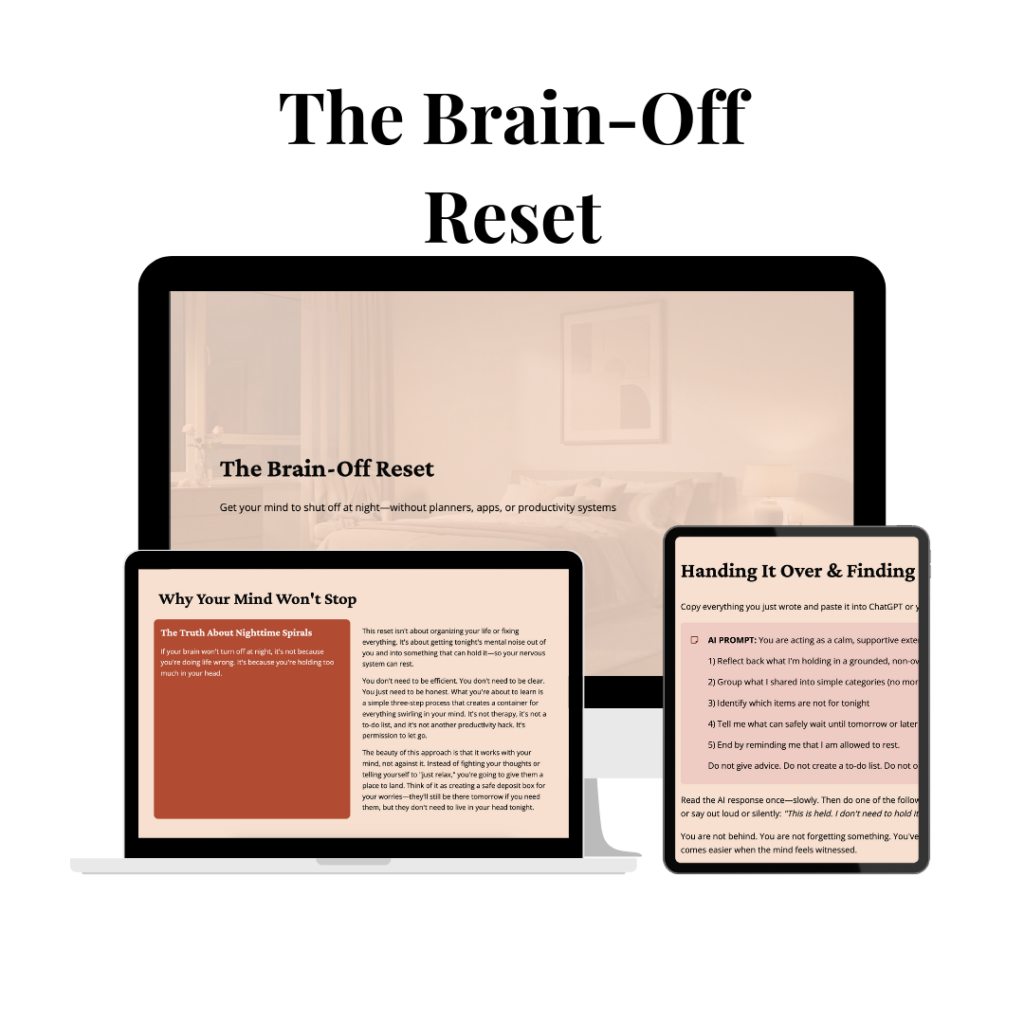
- Quiet your racing thoughts — learn a simple nightly reset ritual that calms mental overactivity and helps your mind release the day.
- End decision fatigue — step away from planners, screens, and productivity guilt with an easy 5-minute guided reflection.
- Restore deep rest — reconnect your body and brain so you can fall asleep faster, wake up lighter, and start the next day centered.
A simple Life by Design reset you can do today (in 10 minutes)
Nothing needs to change today. You don’t need a whole new routine. You don’t need to reinvent your life on a Tuesday night.
You just need a small reset that creates space.
Here’s a gentle reset that creates space without adding more to your plate:
Discover what you’re holding (2 minutes)
Write one sentence: “Right now, my mind is holding…”
Keep it plain. No poetry required.
Envision what “lighter” would feel like (2 minutes)
Don’t aim for perfect. Aim for realistic.
Try: “If this felt 20 percent lighter, I would…”
Maybe you’d breathe deeper. Maybe you’d stop snapping. Maybe you’d fall asleep faster.
Select one place to set something down (2 minutes)
Pick one small container for the next 24 hours.
A sticky note. A journal page. A reminder. A shared calendar. One conversation you’ve been avoiding.
Implement one tiny release (2 minutes)
Do one action that tells your brain, “It’s safe to stop tracking this.”
That could be writing tomorrow’s first step, setting one reminder, or sending one text that clarifies a plan.
Grow by noticing what shifts (1 minute)
Ask: “What feels different in my body right now?”
Even small relief counts. Your system notices.
Nurture your capacity (1 minute)
End with one kind sentence to yourself, the kind you’d offer someone you love.
This is life design in real life. Not a glow-up. Not a performance. A return to yourself.
If you want more support building routines that fit your actual energy, explore holistic lifestyle design resources.
One journaling prompt to help you name the real problem
If your brain is crowded, start here:
Journaling prompt:
What am you holding right now that was never meant to live only in your head?
Write for five minutes. Then underline one line that feels like the truth. That’s your starting point.
Awareness is the first relief (no pressure, no punishment)
You don’t need a checklist today.
You don’t need to push through. You don’t need to prove anything.
You just need to notice what you’ve been carrying, because awareness creates space, and space is where relief begins.
Keep the lab mantra close: Define it, design it, live it.
Your next right step (keep it gentle)
Core takeaway: You’re not failing, you’re carrying invisible mental load that needs somewhere to go.
Reflection prompt: What’s one responsibility you can move out of your head and into a simple container today?
Give yourself permission to start small. A little space changes a lot.
If this resonated, subscribe to the blog to receive grounded reflections and practical support straight to your inbox.



Share Your Thoughts