


You’re getting things done, but you’re also carrying everything. The tiny details. The reminders. The emotional temperature checks. The quiet “Don’t forget” list that lives in your head and never clocks out.
If you’re one of the many women who looks steady on the outside but feels maxed out inside, hear me clearly: this isn’t laziness, disorganization, or a mindset flaw.
It’s emotional load.
I’ve had seasons where my brain felt like it was buffering, even on “easy” days. Nothing was actually wrong, but I felt overstretched. I wasn’t failing. I was full. That’s when I started tracking what I was holding… not just what I was doing.
This blueprint walks you through a simple Emotional Load Tracker so you can finally see the hidden work you carry, sort it by life area, and gently offload about 20% in one week. Small shifts. Honest awareness. Real relief.
What is an Emotional Load Tracker?
An emotional load tracker is a simple way to capture the hidden mental work you carry every day, like remembering, planning, and anticipating needs.
For 48 hours, write down every “Don’t forget,” “I should,” or “I’ll handle it.” Then sort what you wrote into your life areas and choose a small 20% to drop, delay, delegate, or digitize.
You’re not trying to do more. You’re learning to share the load so your mind can rest.
What “emotional load” actually looks like (and why it drains you)
Emotional load is the behind-the-scenes mental work that keeps life running. It isn’t just chores. It’s the thinking, planning, tracking, caring, and anticipating that wrap around them. This is the “mental load” most women carry quietly.
It often sounds like:
- “I need to check in on my mom this week.”
- “Do we have enough groceries for school lunches?”
- “I should follow up with that friend who’s going through something.”
- “I can’t forget the appointment, the form, the deadline.”
This is emotional wellness work because it’s tied to care, responsibility, and belonging. The problem is that when your brain is always scanning for what’s next, it never fully rests. That’s why emotional load feels exhausting even when the day looks simple on paper.
Naming your emotional load doesn’t make you weak. It makes the invisible visible. And once you can see it, you can begin to gently share and reduce it using an emotional load tracker.
If you want a deeper dive into the idea of “mental load” and why so many women carry it silently, this guide from Calm walks through what it is, how it shows up, and ways to begin recovering.
The Emotional Load Tracker Blueprint (built for real life)
This emotional load tracker is a one-week plan you can do in your notes app, a paper journal, or a simple spreadsheet. Keep it light. You’re not building a perfect productivity system. You’re building clarity, ease, and emotional breathing room.
Step 1: Set up your emotional load tracker in 10 minutes
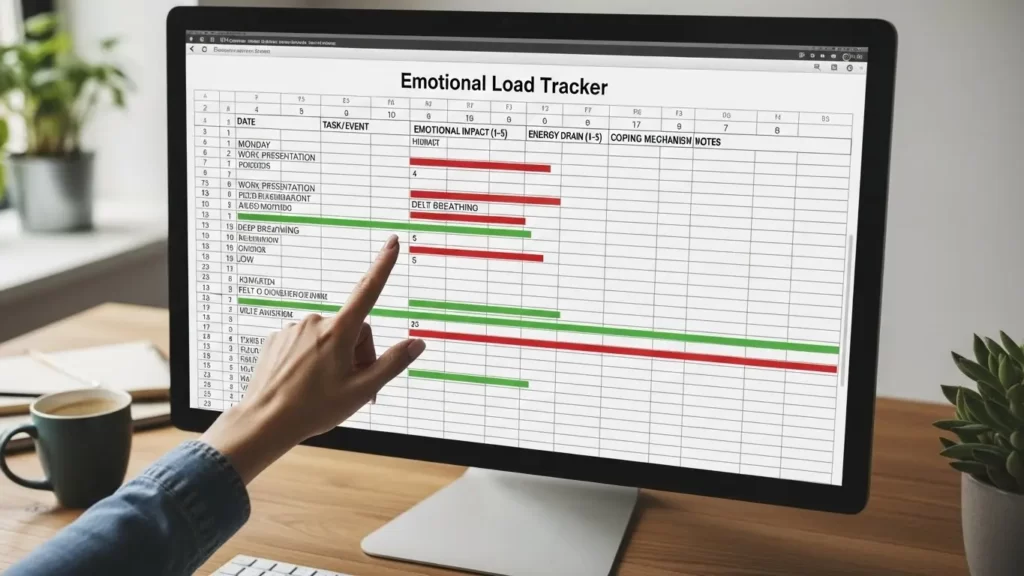
Use any tool that feels easy. If it takes more than 10 minutes, it’s too much.
Here’s a simple format you can use in a notes app, paper journal, or spreadsheet:
| What I’m carrying | Type (mental, emotional, admin) | Life area | Why it’s on me | Offload option |
|---|---|---|---|---|
| “Remember to book the dentist” | admin | health | I always handle scheduling | automate/reminder |
| “Check on my friend” | emotional | relationships | I’m the steady one | share/ask support |
You’re not tracking tasks to judge yourself.
You’re tracking so your mind doesn’t have to hold everything alone.
Step 2: Capture for 48 hours (no fixing yet)
For the next two days, you’re simply noticing your emotional load. Every time your brain says, “Don’t forget,” “I should,” or “I’ll handle it,” write it down in your emotional load tracker.
Keep it low-effort:
- Messy notes count
- Voice notes count
- One-word entries count
You’re in awareness mode only. No organizing. No solving. No judging.
This helps you see how often your mind is scanning for needs, responsibilities, and emotional safety — especially when nobody else is noticing.
Step 3: Sort it by the 8 life areas (so it stops feeling like a personal flaw)
Now take what you collected and sort each item into one of your 8 Life by Design areas:
- Health
- Finances
- Career & Purpose
- Relationships
- Personal Growth
- Environment (home + surroundings)
- Fun & Joy
- Spirituality & Inner Life
When everything sits in one pile, it feels like you are the problem.
When you sort it, you see the truth:
It isn’t that you “can’t keep up.”
It’s that certain areas are quietly loading your mental bandwidth.
That awareness shifts the story from self-blame to clarity. And clarity is what makes your emotional load tracker powerful — it shows you where support, systems, or boundaries will create the biggest relief.
If you want the full framework, use this as your guide: https://digitalwellnessjournal.com/key-life-areas/

Start With Clarity, Not Pressure
If you want help seeing which area of your life needs support first, try the free Personal Life Evaluation Assessment (PLEA). It gently maps your 8 key life areas so you can choose one small rule that makes the biggest difference.
Step 4: Use the DWJ Journaling Cycle to find what’s really happening
This is where your emotional load tracker shifts from “just a list” into gentle self-awareness.
Choose your top five heaviest items and walk them through this quick cycle:
Awareness:
What is the task, exactly?
Emotion & Need:
What feeling shows up (resentment, worry, guilt, pressure)?
What do you actually need (rest, clarity, support, boundaries)?
Alignment:
Does this truly belong to you in this season of your life?
Action:
What is the next small step toward ease?
You’re not trying to be perfect. You’re simply choosing alignment over automatic responsibility. One clear step at a time.
Step 5: Apply the DESIGN framework to your week (so you actually offload)
This is how you turn awareness into real relief without burning out.
Discover
You tracked your emotional load for 48 hours.
Envision
Ask: “What would feel like ease in this area?”
Select
Choose the small 20% you’ll offload first.
Implement
Make the change in minutes, not hours.
Grow
Notice what helped. Adjust what didn’t.
Nurture
Protect your progress with one tiny weekly reset.
That’s intentional living in plain language: notice, choose, adjust, repeat.
Offload 20% with four moves
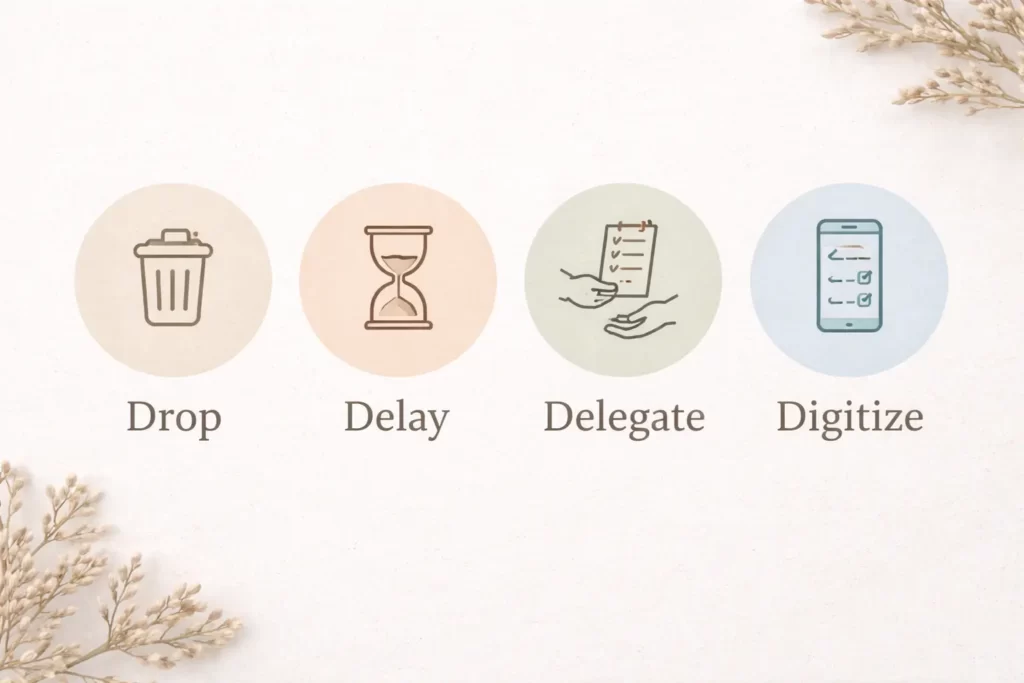
You don’t have to offload everything to feel lighter. Start with the right 20%.
Choose 3 to 7 items from your emotional load tracker and apply one of these:
Drop (delete it)
If nobody would truly suffer, let it go. Some tasks are guilt-based, not purpose-based.
Delay (not now)
Move it to a “later list” with a real date. You’re choosing timing, not failing.
Delegate (share the load)
Ask directly. Name the task. Name the deadline. No hinting. No apologizing.
Digitize (let tech remember for you)
Use reminders, recurring calendar events, or automation so your brain doesn’t have to hold everything.
Connect these shifts to routines you already do (coffee, commute, bedtime). That’s how habits stick: small links, not massive overhauls.
A 7-minute daily rhythm that keeps the load from rebuilding
You don’t need a new system. You just need a small check-in that protects your energy.
Try this once a day for a week:
Step 1 — Name it
What’s taking up the most space in my head today?
Step 2 — Notice the pattern
What keeps repeating here (over-responsibility, people-pleasing, guilt, perfection, fear of letting someone down)?
Step 3 — Feel it honestly
What emotion is present, and can I name it without fixing it?
Step 4 — Choose one gentle shift
What’s one small action that would create more ease in the next 24 hours?
That’s it. Seven honest minutes.
You’re building a rhythm of noticing, naming, and choosing instead of silently carrying everything by default.
One journaling prompt (keep it simple, keep it honest)
If you only do one thing this week, try this in your notes app or journal:
Journaling prompt:
Where am I acting like the “backup brain” for everyone else — and what would change if I carried 20% less this week?
You don’t have to solve it all on paper.
Naming it is the first relief step. Awareness creates choice, and choice is what lightens the emotional load.
FAQ: Emotional load tracking, offloading, and intentional living
Key Takeaways
–Emotional load is the invisible mental work you carry.
–Tracking it helps you see what’s weighing on you, not what’s “wrong” with you.
–Sort what you’re carrying by your 8 life areas to spot where the strain lives.
–Offload about 20% using four moves: drop, delay, delegate, or digitize.
–A simple daily 7-minute check-in keeps the load from rebuilding.
The load gets lighter when it gets named
Your emotional load tracker works because it turns invisible pressure into clear choices. And clear choices create space. You are not trying to become superhuman. You are learning to stop carrying everything by default.
Keep it small. Stay honest. Let this be an experiment in ease, not a test you have to pass.
Reflection prompt:
What’s one hidden task you’re ready to release, even if it feels imperfect?
You’re allowed to want less weight, not just better time management. And if you want support choosing where to begin, start with the free Personal Life Evaluation Assessment so you can see which life area needs care first — without pressure or overwhelm.




Share Your Thoughts